





Looking for a Shorter Overview?
AI Summary
Key Moments
X World as a digital driving simulator
Detailed simulation of complex traffic scenarios for AI training and validation.X Cache acceleration technology
New technology that increases the efficiency of AI simulations by up to 2.7 times.Physical AI strategy
Integrating AI into physical products such as vehicles and robotics for future mobility solutions.Rapidly growing simulation capacity
Annual increase from 30,000 to over 500,000 simulated scenarios with 30 million virtual test kilometers daily.XPENG has unveiled new details about X World, the company’s AI-powered driving simulation platform designed to train and validate next-generation intelligent driving systems. At the same time, the company also unveiled X Cache, a new acceleration technology that XPENG says can increase the efficiency of AI simulations by up to 2.7 times. Together, the technologies will support the development of XPENG’s VLA 2.0 architecture and the company’s broader focus on what the company describes as Physical AI.
A digital driving simulator for AI
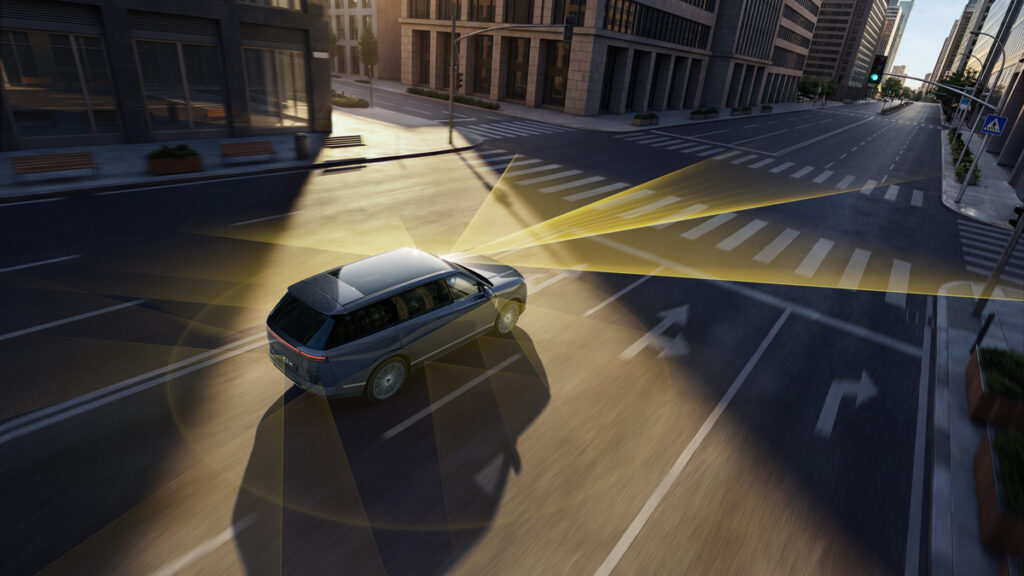
Essentially, X World functions as an advanced and highly realistic artificial intelligence driving simulator. In the same way that pilots train in flight simulators, XPENG now uses X World to digitally recreate complex traffic situations, enabling intelligent driving systems to learn, adapt and improve before corresponding scenarios arise on real roads.
The system can simulate millions of different driving situations in a virtual environment, including dense city traffic, sudden lane changes, heavy rain, unexpected pedestrian movements and other situations that traditionally require extensive testing in real traffic. 





This reduces the need for costly test miles while improving development speed, scalability, and security validation.
XPENG describes examples such as a cyclist suddenly appearing in central Amsterdam, heavy rain on a German motorway or complex urban traffic in Paris. Scenarios that would normally require millions of kilometers of real-world test driving can now instead be recreated digitally and tested on a large scale.
X Cache will speed up AI simulations
XPENG also introduced X Cache, a new acceleration technology developed for AI-based world models.
One of the major challenges of large-scale driving simulation is the enormous computing power required to continuously generate realistic traffic environments in real time. According to XPENG, X Cache solves this by identifying reusable visual information between video frames, reducing redundant computations and increasing inference speed by up to 2.7 times.
This happens without the need to retrain the underlying model.
In practice, this means that X World can be run faster, more efficiently and on a larger scale, bringing real-time AI simulation closer to practical use in the development of autonomous and intelligent vehicles.
Part of XPENG's Physical AI strategy
Together, X World and X Cache form part of XPENG's broader strategy in Physical AI, where artificial intelligence is not only used in digital interfaces but is integrated into real physical products.
For XPENG It's about developing AI technology that can be used in vehicles, robotics and future mobility solutions.
The technologies are already used internally within XPENG's development processes for autonomous driving, including for:
• Closed simulation-based testing
• AI training and reinforcement learning
• Generation of synthetic data
• Safety and performance validation
Simulation capacity is growing rapidly
XPENG states that the company's simulation capabilities have grown rapidly over the past year.
According to the company, the number of simulated scenarios has increased from around 30,000 to over 500,000. Daily virtual testing now corresponds to around 30 million kilometers of driving.
XPENG believes that world models will play an increasingly important role in the future of intelligent driving by making it possible to train AI faster, conduct validation on a larger scale, and at the same time create safer AI systems for global traffic environments.
The development also shows how the automotive industry is increasingly using advanced AI simulation to reduce development costs, shorten test cycles and improve safety before the technology reaches public roads.
With X World and X Cache, XPENG positions itself more clearly in the race for AI-based mobility, where simulation platforms, world models and Physical AI are expected to play a central role in the next generation of intelligent vehicles.
Technical reports and research
XPENG has also published technical reports and research materials about the technologies via arXiv and the company's official research channels.
Among the published reports are:
X World Official Website
https://x-world-1.github.io/
Papers:
X-Cache: Cross-Chunk Block Caching for Few-Step Autoregressive World Models Inference
Research Paper
https://arxiv.org/abs/2603.19979
Official X Cache Website
https://x-cache-1.github.io/
XPENG's effort shows how AI simulation is quickly becoming an increasingly important part of the development of self-driving and intelligent vehicles, where digital training in virtual environments can become as important as physical testing on real roads.
About XPENG
XPENG is a leading technology company that designs, develops, manufactures and markets smart mobility solutions. Our mission is to drive the change towards smart electric vehicle with innovative technology, and shaping the mobility experience of the future.
To optimize the customer's mobility experience, the company has created a full-stack Advanced Driver Assistance System (XPILOT), as well as a smart operating system (Xmart OS) for an enhanced in-car experience. XPENG has also developed core vehicle systems for enhanced driving performance, including powertrains and advanced electronic architecture.
XPENG, which is listed in New York and Hong Kong, is headquartered in Guangzhou, China, with regional headquarters in Beijing, Shanghai, Silicon Valley, San Diego and Amsterdam. The company's smart electric vehicles are mainly manufactured at its factories in Zhaoqing and Guangzhou in Guangdong Province.




















 Swedish
  Danish
  Norwegian
  Finnish
  English
  German
  Dutch
Dutch