

Cybertech Europe 2026-IT Industry Official Media Partner

Password attacks increase 155 times – MFA loopholes open the door to Microsoft 365

Password attacks increase 155 times – MFA loopholes open the door to Microsoft 365 | IT-Branschen Password attacks increase 155 times – MFA loopholes open the door to Microsoft 365 | IT-Branschen
Password attacks increase 155 times – MFA loopholes open the door to Microsoft 365

Looking for a Shorter Overview?

Key Moments

Exponential increase in password spraying

Credential spraying attacks have increased 155 times in the first half of 2026.

MFA doesn't protect all authentication flows

Attackers exploit gaps where MFA does not cover legacy authentication flows like ROPC.

IPv6 complicates IP blocking

Attack traffic via IPv6 makes traditional IP blocking less effective.

Security measures in Microsoft cloud services

Huntress recommends comprehensive MFA requirements, reviewing Conditional Access, and phasing out ROPC.

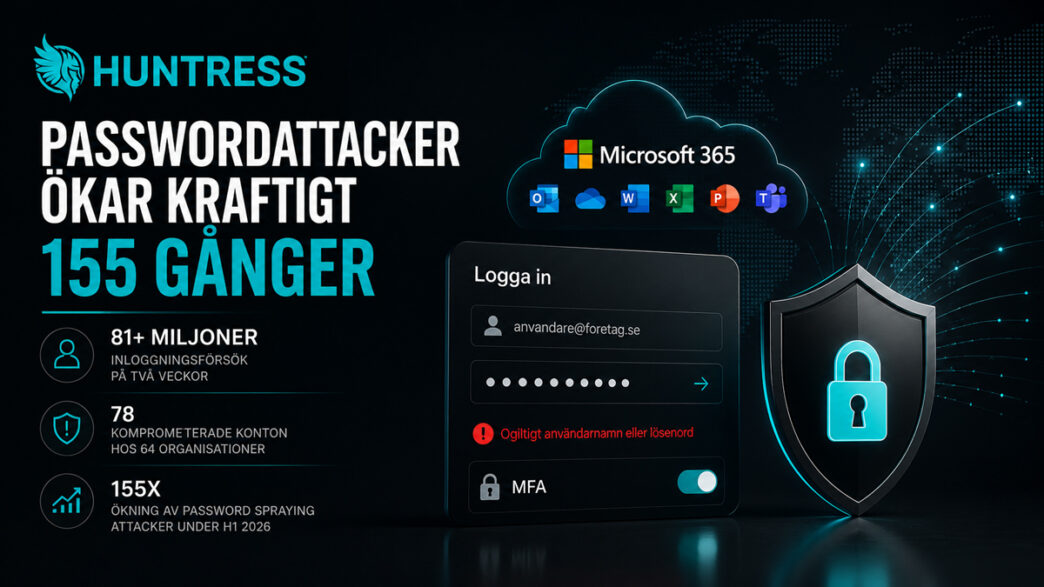
Cyberattacks based on so-called password spraying have increased dramatically in 2026. Security company Huntress states that during the first half of the year it registered a 155-fold increase in credential spraying attacks.

A large-scale campaign against Microsoft's cloud environments also shows how attackers can bypass organizations' security controls without actually breaking multi-factor authentication.

155 times more password spraying attacks in six months is a clear signal: organizations need to ask not only whether MFA is enabled, but whether it truly protects every path into the environment.

In just two weeks, Huntress registered over 81 million login attempts towards customer environments. At least 78 Microsoft accounts at 64 organizations were compromised.

  • Maciek Szczesniak featured on IT-Branschen Wire Channel Magic Chats podcast banner
    Maciek Szczesniak appears on IT-Branschen Wire Channel Magic Chats, discussing leadership, innovation, digital transformation, and business services.
    SPONSORED

  • The IT industry Nordic technology media platform covering cybersecurity, cloud, AI, digital transformation, channel, MSP and enterprise IT news
    The IT industry is a leading Nordic technology media platform covering cybersecurity news, artificial intelligence, cloud computing, enterprise IT, digital transformation, managed services, channel partners, software development, telecommunications, data centers, IT infrastructure, technology leadership, business innovation, and emerging technologies. Through executive interviews, industry analysis, event coverage, thought leadership, product launches, vendor updates, and market insights, the IT industry connects technology decision-makers, CIOs, CISOs, CTOs, IT managers, MSPs, resellers, distributors, technology vendors, startups, and enterprise organizations across Sweden, Norway, Denmark, Finland, and Europe. Coverage includes cybersecurity trends, AI adoption, cloud strategy, enterprise software, networking, digital infrastructure, sustainability, compliance, governance, risk management, automation, data analytics, and future technology developments.
    OWN CONTENT

  • VORTIQ-X AI Governance helps companies transform AI into controllable and verifiable business value.
    VORTIQ-X is an AI Governance platform that helps organizations govern, verify, and create measurable business value from AI. The platform focuses on transparency, compliance, AI governance, and the effective use of AI in mission-critical processes.
    ADVERTISEMENT

  • Cybertech Europe 2026 cybersecurity conference in Rome with the IT industry as Official Media Partner
    Cybertech Europe 2026 is one of Europe's leading cybersecurity conferences, bringing together cybersecurity leaders, government officials, technology innovators, startups, investors, and enterprise decision-makers in Rome. The IT industry serves as an Official Media Partner, providing event coverage, executive interviews, industry insights, and cybersecurity news for Nordic and European audiences.
    ADVERTISEMENT

In several cases, the problem was not that MFA was missing.

The problem was that MFA didn't cover the right authentication flows.

81 million login attempts in two weeks

The extensive campaign was observed between June 12 and 26, 2026, and targeted Microsoft Azure CLI, the command-line tool used for administering Azure resources.

The attackers used automated login attempts on a very large scale, including usernames and passwords that had previously been exposed in data breaches but were still valid.

In total, more than 81 million related login attempts were recorded during the period.

Despite the enormous volume, the attackers managed to compromise at least 78 accounts at 64 organizations.

Huntress' statistics, however, show a much broader trend. Credential spraying attacks against the company's customer base increased 155 times in the first half of 2026.

The attackers didn't need to crack MFA

One of the most striking parts of the attack is that several of the affected organizations were already using multi-factor authentication.

However, the attackers did not need to defeat the MFA technology.

Instead, they exploited gaps in how organizations' Conditional Access policies had been configured.

The attack used, among other things, Resource Owner Password Credentials, ROPC, a legacy OAuth authentication flow where username and password can be sent directly to a token endpoint.

ROPC has been deprecated in OAuth 2.1 and lacks support for modern authentication mechanisms like MFA in the current flow.

The result is that an organization may experience MFA being enabled while still leaving some authentication paths unprotected.

MFA is not enough if the policy has gaps

Huntress analyzed 23 businesses that were affected by the campaign.

Eight of these lacked MFA altogether.

At the remaining 15 businesses, the MFA configuration did not cover the attackers' login attempts.

Among the problems were Conditional Access policies that only covered certain applications or user groups, exceptions for trusted locations, and policies that were in reporting mode and therefore did not actually block authentication.

It illustrates a central challenge for modern identity environments.

Just because an organization has implemented MFA does not automatically mean that all users, applications, and authentication methods are protected.

Password spraying is different from traditional brute force

In a traditional brute force attack, the attacker tests large numbers of passwords against a single account.

Password spraying works differently.

Instead, the attacker tests a limited number of common or previously compromised passwords against a large number of user accounts.

By spreading the attempts across many identities, the attacker can reduce the risk of traditional account lockouts and security mechanisms being activated.

Once valid credentials are found, they can be used for continued access, data theft, Business Email Compromise, or further identity attacks.

In the current campaign, observed Huntress However, there was no subsequent activity from the successfully compromised accounts. One possible explanation raised by the security firm is that the attackers may have verified working credentials for resale.

IPv6 makes blocking more difficult

The attack infrastructure also shows how threat actors are changing their methods.

A large portion of the traffic originally came from an IPv6 range connected to the internet service provider LSHIY LLC.

IPv6 offers a very large address space, which can make traditional IP-based blocking significantly more difficult.

Additionally, when the original infrastructure was shut down, Huntress observed how activity shifted to other networks and providers.

For security teams, this development means that static block lists and individual IP addresses are becoming less effective as a primary defense.

Huntress recommends stricter identity checks

For organizations using Microsoft's cloud services, Huntress points to several measures.

Organizations should, among other things:

  • require MFA for all users, cloud applications, and client types
  • review and minimize exceptions in Conditional Access
  • block authentication methods that cannot meet MFA requirements
  • phase out ROPC where it is still used
  • restrict Azure CLI to users who don't need the tool
  • improve password hygiene and consider password-free authentication methods
  • Prioritize incidents where valid credentials are identified, rather than solely based on the number of failed logins

Identity is becoming an increasingly important attack surface

Developments in 2026 show how cyberattacks are increasingly targeting identities and authentication flows rather than traditional technical vulnerabilities.

This also means that investments in MFA alone are not a guarantee of strong identity protection.

For companies that use Microsoft 365, Entra ID and Azure, the configuration of Conditional Access is therefore at least as important as the actual implementation of multi-factor authentication.

155 times more password spraying attacks in six months is a clear signal: organizations need to ask not only whether MFA is enabled, but whether it truly protects every path into the environment.

Related Posts

Sharp increase in brute force attacks against network devices – 88 percent linked to the Middle East

Barracuda's latest Threat Radar shows a clear increase in brute force attacks against network devices during the first quarter of this year. Between January and March 2026, a significant increase was recorded

ConsentFix and ClickFix: How to hijack Microsoft 365 accounts in just seconds

ConsentFix and ClickFix are two advanced attack methods that leverage legitimate authentication flows and user behaviors to hijack Microsoft 365 sessions without stealing passwords. Here…

Identity attacks the most common cyber threat – abnormal logins top security alerts

A new Barracuda report shows that identity-based attacks are now the most common type of cyberthreat. Aberrant Microsoft 365 logins and so-called impossible travel are clear indicators…

Questions Answered

What is password spraying and how is it different from brute force?

Password spraying tests a few passwords against many accounts instead of many passwords against one account.

Why can attackers bypass MFA in Microsoft 365?

Gaps in Conditional Access and legacy authentication flows like ROPC lack MFA support.

How does IPv6 affect attackers' methodology?

The large address space makes IP blocking more difficult to implement effectively.

What measures are recommended for better protection in Microsoft cloud environments?

Require MFA for all users, review Conditional Access, and phase out ROPC.

Stay up to date with the most important news

By pressing the Subscribe button, you confirm that you have read and agree to our privacy policy and terms of use
  • Maciek Szczesniak featured on IT-Branschen Wire Channel Magic Chats podcast banner
    Maciek Szczesniak appears on IT-Branschen Wire Channel Magic Chats, discussing leadership, innovation, digital transformation, and business services.
    SPONSORED

  • Cybertech Europe 2026 cybersecurity conference in Rome with the IT industry as Official Media Partner
    Cybertech Europe 2026 is one of Europe's leading cybersecurity conferences, bringing together cybersecurity leaders, government officials, technology innovators, startups, investors, and enterprise decision-makers in Rome. The IT industry serves as an Official Media Partner, providing event coverage, executive interviews, industry insights, and cybersecurity news for Nordic and European audiences.
    ADVERTISEMENT

  • The IT industry Nordic technology media platform covering cybersecurity, cloud, AI, digital transformation, channel, MSP and enterprise IT news
    The IT industry is a leading Nordic technology media platform covering cybersecurity news, artificial intelligence, cloud computing, enterprise IT, digital transformation, managed services, channel partners, software development, telecommunications, data centers, IT infrastructure, technology leadership, business innovation, and emerging technologies. Through executive interviews, industry analysis, event coverage, thought leadership, product launches, vendor updates, and market insights, the IT industry connects technology decision-makers, CIOs, CISOs, CTOs, IT managers, MSPs, resellers, distributors, technology vendors, startups, and enterprise organizations across Sweden, Norway, Denmark, Finland, and Europe. Coverage includes cybersecurity trends, AI adoption, cloud strategy, enterprise software, networking, digital infrastructure, sustainability, compliance, governance, risk management, automation, data analytics, and future technology developments.
    OWN CONTENT

  • VORTIQ-X AI Governance helps companies transform AI into controllable and verifiable business value.
    VORTIQ-X is an AI Governance platform that helps organizations govern, verify, and create measurable business value from AI. The platform focuses on transparency, compliance, AI governance, and the effective use of AI in mission-critical processes.
    ADVERTISEMENT