



Looking for a Shorter Overview?
AI Summary
Key Moments
Shortcomings in AI guidelines
Many Nordic workplaces, especially in Sweden, lack or have inadequate AI guidelines.Clear guidelines increase AI use
Organizations with clear and enforced AI guidelines see higher daily use of AI.The impact of the EU AI Regulation
From 2025, increased requirements will be placed on control, competence and documentation regarding AI in working life.Rapid development possible
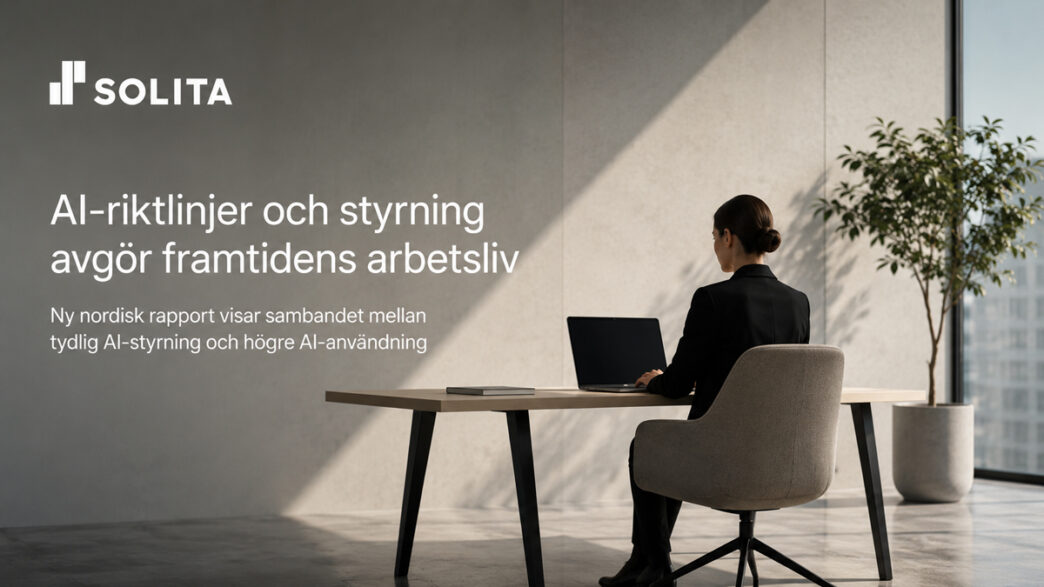
Finland has rapidly improved AI governance, showing that change can happen quickly with prioritization.Office workers in Sweden, Finland and Denmark report significant gaps in internal guidelines for how AI can be used in the workplace. A new survey, commissioned by AI and data transformation company Solita, shows that organizations with clear AI guidelines and high compliance also have a higher use of AI in daily work.
The report How AI is Transforming Nordic Work Life in 2026 has been produced by Kantar Media on behalf of Solita and includes more than 3,000 office employees in Sweden, Finland and Denmark. The survey shows that 14 percent of Swedish employees state that their employer lacks internal AI guidelines. The corresponding proportion is 10 percent in Denmark and 7 percent in Finland. At the same time, the report shows that countries where employees are more likely to follow the organization's AI guidelines also have a higher use of AI in daily work.
Sweden lags behind its Nordic neighbors
Sweden lags behind in both AI guidelines and compliance. Only 63 percent of Swedish office workers say they always follow their employer’s AI rules. The corresponding figure is 68 percent in Finland and 71 percent in Denmark. 




The survey also shows that communication around AI policies needs to be improved. A full 11 percent of Swedish employees do not know if their employer even has any AI guidelines.
EU AI regulation increases requirements for companies
The EU AI Act began to be phased in in 2025 and will be fully applicable by 2027. For employers, this means increased demands for control over how AI is used, which tools are used and what AI skills employees need.

“Many Swedish companies have focused on getting started with AI quickly, but have not laid the necessary foundation. The result is that employees experiment without clear frameworks, which creates both security risks and uncertainty about what is actually acceptable in the workplace. As regulations tighten, the lack of governance becomes a concrete business risk,”, says Rebecca Hammel, SVP AI & Cloud Development at Solita Sweden.
Denmark leads the way
The report challenges a common assumption. Clear AI guidelines do not slow down its use. On the contrary, they seem to contribute to more people using AI.
Denmark has the highest level of compliance among the three countries, with 71 percent saying they always follow their employer’s AI guidelines. It also has the highest use of generative AI. Overall, 65 percent use generative AI at work, and 24 percent do so daily.
The corresponding figures for Sweden are 53 and 14 percent, respectively, while Finland is 62 and 17 percent, respectively.
“This is the biggest misconception we see among business leaders right now. Guidelines are often seen as something that slows down development, but the survey shows the opposite. When employees know what they are allowed to do, they dare to experiment more and invest time in learning the tools properly. It is the lack of clarity, not the guidelines, that actually slows down development,”, says Rebecca Hammel.
Finland shows how quickly developments can change
Finland shows that progress can be made quickly when AI governance is prioritized. In just one year, the proportion of employees who say their organization lacks AI guidelines has dropped from 21 to 7 percent, a decrease of two-thirds.
At the same time, the proportion who always follow their employer's AI guidelines has increased from 58 to 68 percent.
“Finland shows that this is not a structural problem that will take years to solve, but something that can change quickly when the issue is prioritized. Swedish companies have about a year to catch up before the most important parts of the EU AI Regulation begin to be fully implemented,” says Rebecca Hammel.
About the survey
The report How AI is Transforming Nordic Work Life in 2026 is based on a survey conducted by Kantar Media on behalf of Solita between October 30 and November 11, 2025.
A total of more than 3,000 office workers in Sweden (n=1,037), Finland (n=1,042) and Denmark (n=1,019) participated. The survey was conducted using nationally representative web panels among people between the ages of 20 and 65.
The report builds on Solitas previous survey from 2024 in Sweden and Finland. This year's edition includes Danm















 Swedish
  Danish
  Norwegian
  Finnish
  English
  German
  Dutch
Dutch