



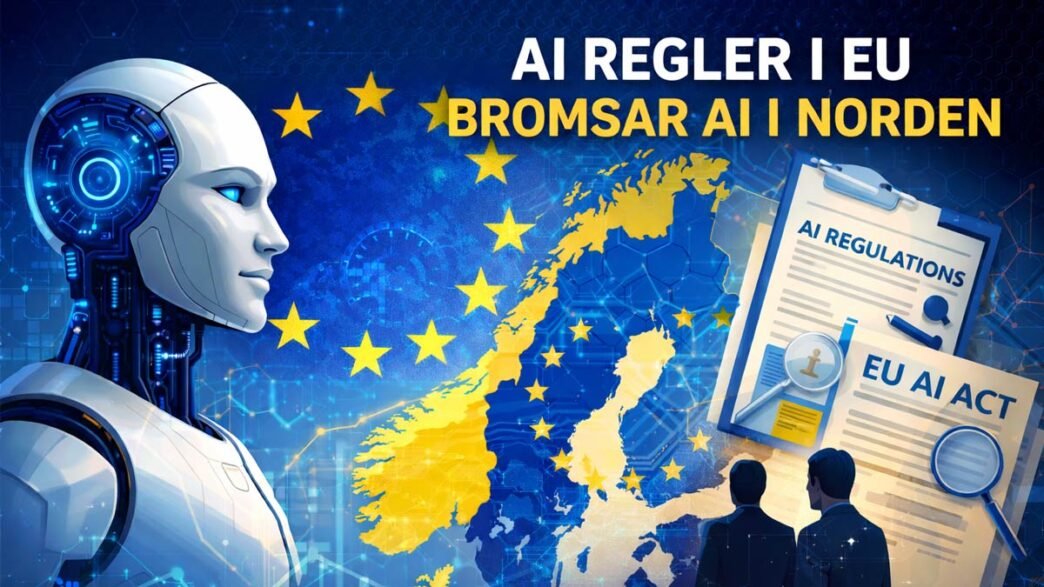
Uncertainty around AI regulations in the EU is currently slowing the development of AI in Nordic companies as new regulations approach full implementation.
All parts of the EU's AI regulation will soon come into full force, but a new survey among Nordic companies shows that much work remains to be done. Uncertainty about laws and regulations is causing many AI projects to slow down or stop altogether.
A new international compliance survey from NAVEX shows that there are still major challenges for Swedish and Nordic businesses in preparing for AI legislation. Since the regulation came into force, the EU's AI framework has gradually begun to be implemented, a process that is expected to be fully completed by early August 2026.


In the survey, only 30 percent of Nordic respondents say they are fully prepared to handle the upcoming AI regulations. At the same time, 60 percent say they are working on preparing their businesses but are not yet there.
Only 26 percent believe that the company's internal guidelines for the safe and responsible use of AI tools are very clear. Almost as many, 24 percent, feel that the guidelines are unclear, which creates uncertainty about how AI is used in daily operations.

According to Vincent Vacher, Europe North Regional Leader at NAVEX, there is clear room for improvement for Nordic business.
He believes that a key step is to create clear local frameworks and at the same time allocate resources to train staff. Failure to do so will hinder the ability to create real business value from AI initiatives, which in turn can lead to bottlenecks and costly dead ends.
In the past 12 months, 55 percent of respondents have experienced one or more AI projects being halted. For 20 percent of companies, uncertainty about EU AI regulations has been a contributing factor to AI initiatives being cancelled. Other factors such as regulatory compliance and ethical issues are cited as contributing factors by 18 and 11 percent of companies, respectively.
The survey also shows that AI is being used despite uncertainty about internal policies. Only eight percent of respondents say they never rely on AI-generated recommendations when they are unsure whether the use is consistent with internal policies. Meanwhile, 24 percent say they do so regularly and 14 percent say they do so all the time.
The study was conducted by OnePoll in January 2026 on behalf of NAVEX. The Nordic sample includes 100 decision-makers from Sweden, Norway and Denmark, all from organizations with more than 500 employees. Also the UK, France, Germany, Switzerland and the USA are included in the survey.
For many organizations, the challenge is not about technology but about governance, accountability and legal clarity. As AI regulations in the EU become an integral part of everyday business, the need for clear internal guidelines, training and governance structures increases. Companies that establish this early reduce the risk of friction and can more quickly translate AI investments into tangible business benefits.










 Swedish
 Danish
 Norwegian
 Finnish
 English
 German
 Dutch
Dutch