



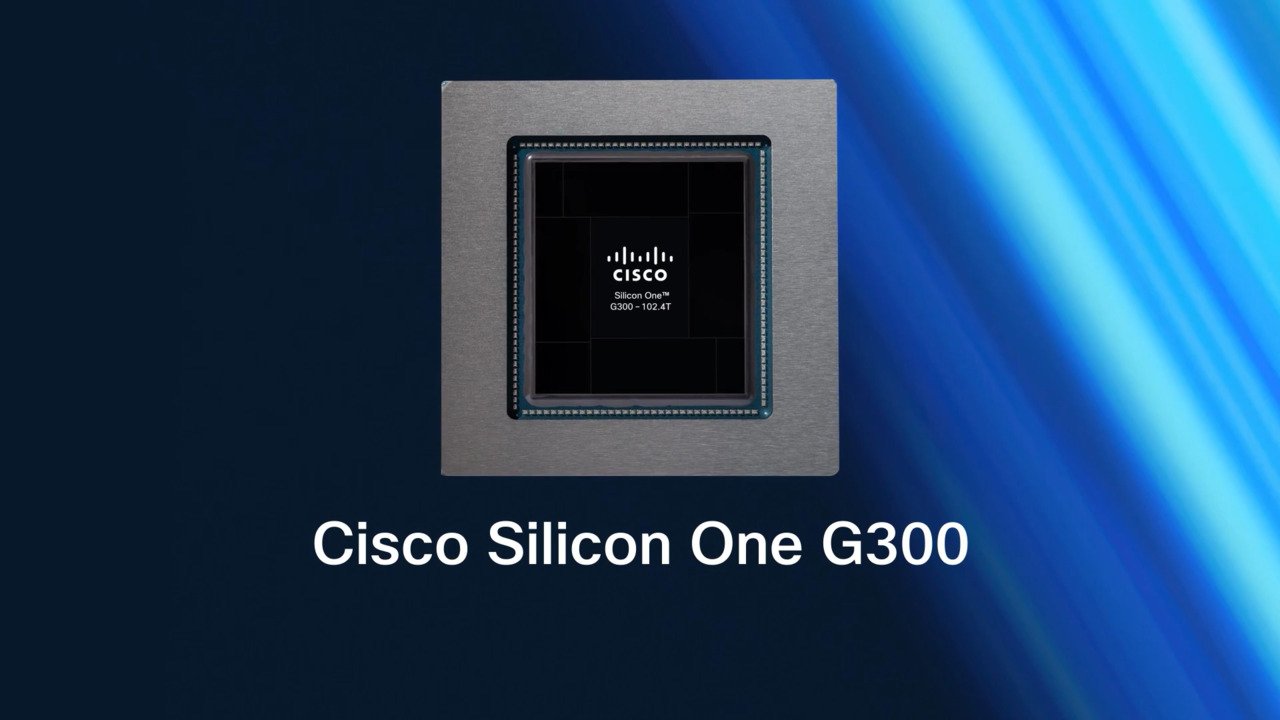

In connection with Cisco Live in Amsterdam Cisco has unveiled the next generation of networking chips in the company's own Silicon One family. Cisco also showed off the first networking products with the chip, which is designed to address the challenges of the next stage in the deployment of AI infrastructure.
As AI evolves towards larger, more complex, and autonomous systems, the demands on network capacity are increasing at a rate that makes it unrealistic to keep up with legacy methods. Capacity expansion must be done in a way that prioritizes efficiency, both in terms of energy consumption and operational costs.
Cisco Silicon One G300 is a new generation of chips built for large, gigawatt-scale AI clusters. With a transfer performance of 102.4 terabits per second and Intelligent Collective Networking – a series of processes and telemetry tools to optimize GPU usage – it enables a 28 percent time saving to complete a task, and a 33 percent increase in network utilization. 



The target group is all actors who are interested in building resilient and flexible AI infrastructure for model training, interference and large real-time workloads; for example, hyperscalers, sovereign clouds, operators and neoclouds.

”Data mobility becomes key to efficient AI computing, and the network becomes part of the computing itself. It’s not just about faster GPUs – the network must offer scalable bandwidth and reliable data transfer without congestion,” says Jeetu Patel, President and Chief Product Officer at Cisco.
The first products based on Silicon One G300 architecture are the N9100 network switch and the Cisco 8000 router. These are equipped with full-coverage liquid cooling and new advanced optics that improve energy efficiency by nearly 70 percent and increase operational reliability. A single system offers the same bandwidth as six systems in the previous generation. This enables users to create greater value from AI investments.
The software-defined network architecture Cisco Nexus One, which was launched in 2025, will also receive new functionality and increased observability, including by Nexus One will be fully integrated with Splunk during the month of March.
Silicon One G300 and products with the chip will be available on the market in 2026.








 Swedish
  Danish
  Norwegian
  Finnish
  English
  German
  Dutch
Dutch