


DeepL shows in a new study that 64 percent of Swedish companies miss out on international growth due to language barriers. Despite Sweden often ranking among the world's top countries in terms of English proficiency, language friction still affects innovation, decision-making and international expansion.
Despite Sweden often ranking among the world's top countries in terms of English proficiency, a new study from DeepL shows that language barriers still affect Swedish companies to a much greater extent than many believe. The consequences are felt not only in daily collaboration but also in innovation, decision-making and international growth.
Language barriers limit companies' potential
The survey shows that Swedish companies do not have full access to the expertise available within their organizations. This applies even at the highest management level.


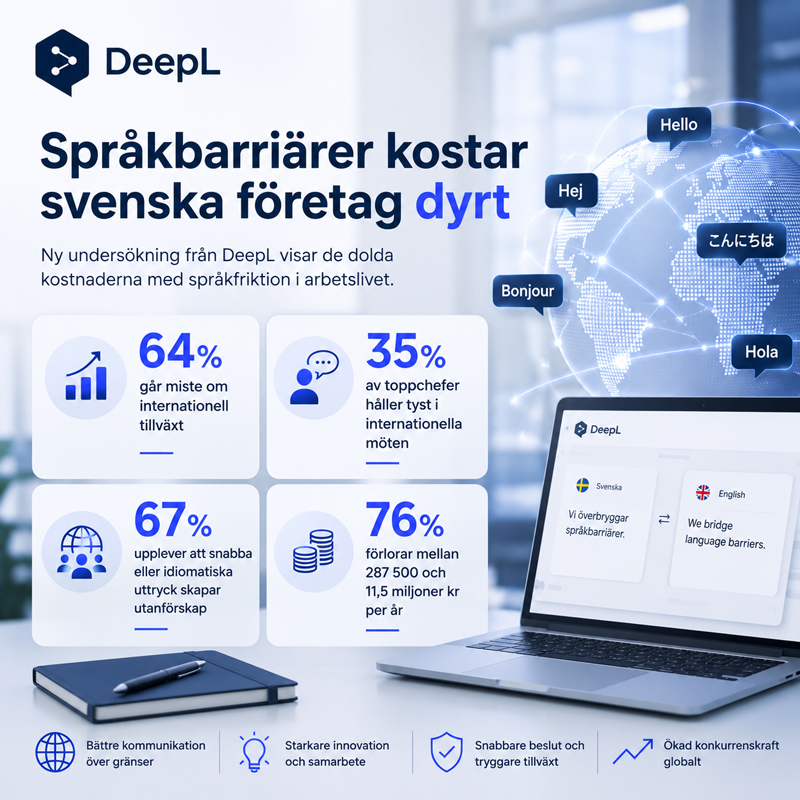
Whole 35 percent of Swedish managers in company management state that they sometimes choose not to express their opinions during international meetings because they are afraid of appearing less competent when communicating in English.
According to DeepL Language friction also leads to clear business consequences:
- 69 percent states that product and service launches are being delayed.
- 68 percent believes that innovation is being slowed down.
- 64 percent says the company is missing out on international growth opportunities.
The survey also shows that 34 percent of Swedish professionals have at some point misunderstood the company's strategy or business goals due to language-related communication problems.
It's not just about English skills
The results also show that the problem is not primarily about Swedish employees having insufficient language skills.
Instead, it states 67 percent that native English speakers often unconsciously create alienation by speaking quickly, using idiomatic expressions or referring to cultural contexts that not everyone in the meeting is familiar with.
This means that important perspectives and ideas risk never coming to light.
Many assume that Swedish professionals have no problem speaking English, but our research shows the hidden psychological costs of language barriers. When skilled employees hold back their best ideas to avoid being perceived as less knowledgeable, a culture of hesitation is created. For companies, this ultimately means lost revenue and reduced growth.
– Larger Swedish companies can meet this challenge with AI-powered real-time speech translation. The technology reduces language barriers, improves decision-making and enables more people to communicate naturally and with the same confidence as in their native language. This way, companies no longer risk missing out on important insights simply because of limited language skills, says Jarek Kutylowski, CEO and founder of DeepL.
Communication affects productivity
Language barriers also have clear consequences for daily work.
The survey shows that:
- 57 percent state that they always or often leave international meetings without having understood important details, technical discussions or crucial decisions.
- 100 percent say they consciously change the way they communicate during multilingual meetings to ensure they are understood.
- 34 percent speaks less during international meetings.
- 28 percent refrain from presenting more complex ideas altogether because they have difficulty formulating them in English.
This means that companies risk missing out on important perspectives, ideas and experiences that could otherwise have contributed to better decisions.
Communication problems cost millions
Language barriers not only affect collaboration but also the finances of companies.
More than three out of four respondents, 76 percent, estimate that their organization loses between SEK 287,500 and SEK 11.5 million per year as a result of communication problems linked to language.
The results show that investments in better language support and AI-based translation solutions can have an impact far beyond more efficient communication and also contribute to increased competitiveness and improved business results.
About the survey
The survey was conducted by Censuswide between May 7 and 18, 2026 and includes 300 Swedish professionals over the age of 25.
Respondents work in a variety of industries at medium-sized and large companies with international operations and multilingual work environments. Participants include both decision-makers responsible for implementing translation solutions and employees who use translation tools at least once a month.
About DeepL
DeepL is a global AI company that develops language technology for international business communication. The company's Language AI platform is used by over 200,000 business teams and millions of users worldwide to communicate, collaborate and work across language boundaries in real time.
By combining advanced AI models with enterprise-grade security and privacy, DeepL helps organizations work effectively across markets and cultures. Founded in 2017 by CEO Jarek Kutylowski, the company now has more than 900 employees and is backed by investors including Benchmark, IVP, and Index Ventures.








 Swedish
 Danish
 Norwegian
 Finnish
 English
 German
 Dutch
Dutch