

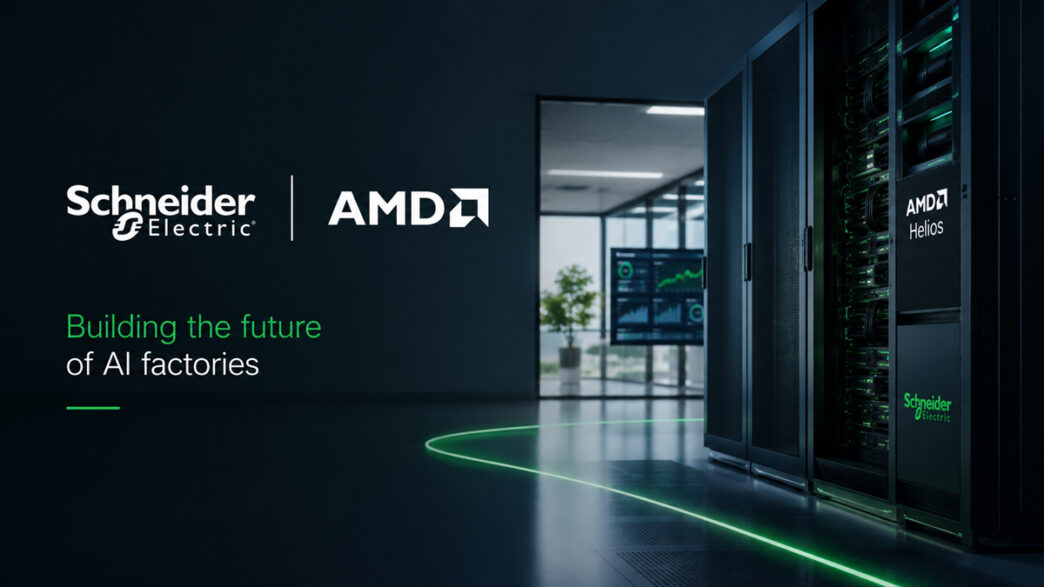

Schneider Electric and AMD are today announcing a jointly developed and validated reference design for AMD’s rack-based Helios solution, designed to make it easier to deploy scalable, high-power density AI environments faster and with lower risk.
The launch marks the first milestone in the collaboration between Schneider Electric and AMD. The companies' shared ambition is to simplify the path from planning to deploying large-scale AI data centers, known as AI factories. The collaboration combines AMD's innovation in AI platforms with Schneider Electric expertise in power, cooling and digital infrastructure. The result is a more integrated model for both new-build AI data centers and upgrades of existing data centers to higher power densities.
The new reference design is the first to be developed specifically to support high-density applications for AI on the AMD Helios platform. The solution is built on AMD Instinct™ MI455X GPUs, 6th Gen AMD EPYC™ processors, AMD Pensando™ Vulcano network adapters, and the ROCm™ open software ecosystem. 

AMD Helios is designed to deliver higher AI performance through improved compute capacity, greater inter-system bandwidth, expanded memory capacity, and system-level integration. This enables it to handle larger and more complex AI workloads faster, while optimizing energy and resource efficiency.
As AI workloads increasingly place greater demands on data center infrastructure, validated reference designs are becoming an essential support for data center architects and operators. By modeling the performance of the physical infrastructure, pre-validated designs can shorten the planning process and clarify how power, cooling, and IT infrastructure should be organized to create reliable, scalable, and AI-ready data centers.
“Today, organizations need comprehensive, AI-ready reference designs that enable faster time from planning to deployment while reducing risk. Through our collaboration with AMD, we are delivering a technically sound reference design that bridges the gap between advanced AI compute platforms, energy technology, and practical data center implementation. This enables customers to deploy scalable, high-density AI environments with greater confidence, efficiency, and speed,” said Dr., says Manish Kumar, Executive Vice President, Secure Power & Data Centers at Schneider Electric.
– AI infrastructure is rapidly evolving towards full-scale AI factories, which requires computing capacity, networking, power supply and cooling to be designed together from the start. AMD Helios offers an open, rack-level architecture designed to deliver the performance, efficiency, and flexibility required for next-generation AI workloads.
By collaborating with Schneider Electric to develop a validated reference design, we provide customers with a practical model to accelerate high-density AI implementations, reduce integration risks, and scale up with greater confidence and efficiency, says Forrest Norrod, Executive Vice President and General Manager of the Data Center Solutions Business Group at AMD.
The AMD Helios reference design encompasses four key technology areas: power, cooling, IT space, and software for management throughout the entire lifecycle of the facility.
The reference design supports:
• Modular environments with multiple clusters and AI clusters with an IT capacity of up to 10.4 MW for new build facilities.
• High power density AI workloads of up to 246 kW per rack.
• Advanced liquid cooling with CDU-based solutions from Motivair by Schneider Electric as well as hybrid solutions that combine air and liquid cooling that can dissipate up to 84 percent of the heat.
• A digital infrastructure that includes:
- Electrical and cooling systems validated with ETAP and CFD simulation in EcoStruxure™ IT Design. The tools enable real-time monitoring and analysis, AI-based predictive maintenance, and system-level optimization of power, cooling, and IT.
- Integrated digital twins for power systems that can be used to model, analyze, and manage infrastructure performance.
- Support from AVEVA Unified Operations Center for real-time monitoring and visibility into operations.
• Power and cooling infrastructure that complies with AMD Helios platform requirements, reducing integration complexity and deployment risks.
• Improved energy efficiency with the possibility of achieving a PUE value of approximately 1.12 at full load.
The reference design has been validated against ANSI standards for installations in the US and the plan is to extend the framework to also support IEC standards for global installations.
Read more about the reference design here.










 Swedish
  Danish
  Norwegian
  Finnish
  English
  German
  Dutch
Dutch