




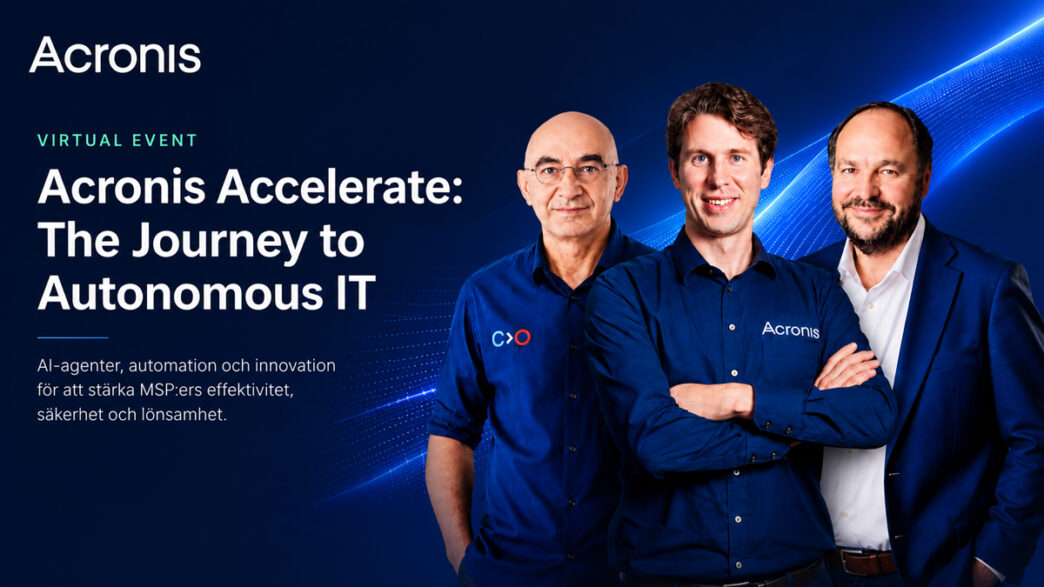

Artificial intelligence is rapidly changing how companies develop software, operate infrastructure, and deliver IT services. During Acronis Accelerate: The Journey to Autonomous IT Acronis presented its vision for the next step, where AI agents will become an integral part of daily IT operations and help Managed Service Providers (MSPs) automate everything from incident management to business development.
The conference brought together several well-known profiles in the IT and cybersecurity industry. Among the speakers were: James Abercrombie, who moderated the event, Jan-Jaap Jager, CEO of Acronis, Serge Bell, founder of Acronis and chairman of Constructor Group, Paul Maritz, former CEO of VMware, Yuri Averkeep from Acronis, Jurgen Weiss, Head of Operations at ARIS and CISO at Sigma Vista, Rob Rae, Corporate Vice President at Pax8, as well as Warren Adelman, Chairman of the Board of Directors of Acronis. The event was conducted together with partner companies such as Fortinet, Seagate, Equinix, Intel, Google Cloud and Pax8.
AI is changing the MSP market
During the opening remarks, Jan-Jaap Jager described AI as the biggest technology shift since the cloud, but with a much faster pace of change. According to him, MSPs can no longer wait for the market to stabilize, but need to continuously test new AI solutions, learn lessons, and quickly put them into practice. 



At the same time, he pointed to several challenges. The costs of data centers, computing capacity and AI infrastructure continue to increase, while customers are placing higher demands on advice around AI, security and automation. This means that MSPs need to gradually evolve from traditional operations providers to strategic advisors in AI and digital transformation.
Four new AI-native platforms
The majority of the conference focused on the new platforms that together will form the basis for Acronis Autonomous IT.
CyberConsole brings together technical operations, AI agents and business intelligence in a common interface where both technicians and business managers get a unified overview of the business. The platform is built with AI at its core and will reduce the need to switch between multiple different tools.
Cyber Intelligence analyzes data from the entire environment and prioritizes which incidents, risks and business opportunities require attention. The solution should not only display statistics but also provide recommendations and, when the organization chooses, automate certain actions.
Acronis Service Desk uses AI to group similar incidents, analyze history, and suggest solutions before a technician even opens a case. The goal is to reduce manual work while maintaining full traceability and control.
With CyberStudio MSPs can also create their own AI agents and workflows using natural language. The platform includes ready-made templates but also provides the opportunity to build their own automations that can be customized to different customer needs. All changes are logged and must be approved before they are used in production.
Focus on open development and modern infrastructure
Acronis founder Serg Bell at the same time highlighted the importance of open development through the initiative Constructor Fabric, an open source project that aims to give developers better governance, quality assurance and control when using AI for software development. He said that AI will change how software is built, but that the need for skilled developers and clear governance is increasing rather than decreasing.
Former VMware CEO Paul Maritz focused instead on the infrastructure behind AI. He pointed to a growing need for distributed infrastructure, smaller language models, and greater freedom of choice as companies want to maintain control over data and AI workloads. He also highlighted CyberFrame as an alternative for organizations considering leaving VMware.
IT Industry Analysis
Perhaps the most important news from Acronis Accelerate is not a single product, but the company's ambition to build a AI-native platform where security, backup, automation, support and business processes share the same foundation and can interact through AI.
While many vendors today offer AI assistants on top of existing products, Acronis’ strategy is to integrate AI into the very core of the platform. If the company succeeds in translating that vision into practice, it could represent a clear shift for the MSP market, moving the focus away from manual tasks and toward AI-driven workflows that leave humans at the helm.
At the same time, it remains to be seen how quickly the market is ready to take the step towards more autonomous IT environments. Issues around governance, security, regulatory compliance and customer trust are likely to be at least as crucial as technological developments.
One thing is clear, however, Acronis Accelerate. AI has moved from being an add-on to becoming a central part of how future IT services will be developed, delivered and managed. For MSPs, this could mean both new business opportunities and new skills requirements in the years to come.





 Swedish
  Danish
  Norwegian
  Finnish
  English
  German
  Dutch
Dutch