

VORTIQ-X has built and verified a model-neutral execution layer between AI intent and mission-critical consequence. The next competitive advantage is therefore not just about who develops the strongest model, but about who can decide exactly what AI is allowed to do – before the action becomes real.
AI enters a new phase
The AI industry is entering a new phase. Language models continue to evolve rapidly, but competition is increasingly determined by infrastructure around them: data centers, semiconductors, energy supply, cloud platforms, and the control mechanisms that make autonomous AI systems safe to use in mission-critical environments.
In enterprises, the model's response is no longer always the end product. AI agents can initiate workflows, read and move data, modify records, invoke tools, and create financial or legal obligations. As AI moves from generating content to causing real-world consequences, the core question also changes: not just what the model can say, but what the system is actually allowed to do.

That shift was the focus of an episode of All-In Podcast which was published on July 11, 2026. Jason Calacanis, David Sacks, Chamath Palihapitiya, and guest contributor Brad Gerstner – replacing David Friedberg – discussed OpenAI, Anthropic, Meta, AI investments, among other things, open versus closed model development and geopolitical competition. The broader signal was clear: The AI race is less and less about a single model and more and more about the capital, energy and control systems that make AI operational on a large scale.
The AI race moves from models to operational infrastructure
Over the past two years, the AI industry has been dominated by the battle for the most capable the language models. OpenAI, Anthropic, Google, Meta and xAI continues to develop model capacity, while Microsoft, Amazon, Google and other major players are tying up very large amounts of capital in computing capacity, networking, storage and energy supply.
Behind the model headlines, a deeper shift is taking place. Data center capacity is expanding rapidly, semiconductors and power supplies have become strategic bottlenecks, and AI platforms are being shaped to handle ever more models and agents. The physical infrastructure determines who can train and run AI at scale.
But the physical warehouse is only one half. When models are connected to business systems, operational control is also required: which identity is allowed to act, under what mandate, with which model and which tool, against which data, for what purpose, to which destination and under which policy. Whoever controls the computational capacity can run the model. Whoever controls the authority to act decides whether the model's proposals can become reality.
Capital, energy and AI become a geopolitical issue
AI has also become a matter of national competitiveness. The US, China and Europe are investing in semiconductor supply, data centres, power grids, skills and digital sovereignty. Access to computing capacity is no longer just a technical issue; it affects industrial capacity, security and the ability to develop their own AI ecosystems.
For European organizations, this is reinforced by the demands for data locality, jurisdiction, traceability and accountability. When an AI agent can act across multiple clouds, models and business systems, destination, policy version and recoverability cannot be treated as afterthoughts. They need to be part of the execution decision itself.
For investors and executives, it is therefore not enough to ask which model performs best today. The longer-term question is which actors can build sustainable AI ecosystems where models can be changed, policies can be maintained, and actions can be controlled without locking the business into a single model or cloud provider.
Autonomous AI systems move control to the moment of action
More and more organizations are using AI agents that can initiate workflows, make discrete decisions, and interact with business systems without continuous human guidance. This creates productivity gains, but also shifts risk from the model’s response to the consequences that response may trigger.
Traditional AI governance, output filters, operational visibility, and logging are important, but they are not enough on their own. A post-event audit can explain what happened, but it cannot always prevent the wrong data from being exported, an unauthorized change from being made, or a business obligation from being created.
Every relevant AI-initiated action therefore needs to be able to be checked before execution and verified afterwards. The model or agent may propose an action, but it may not create its own authority. The authority must come from a separate, verifiable control layer that can approve, transform, hold, block or require rollback readiness before the consequence is passed through.
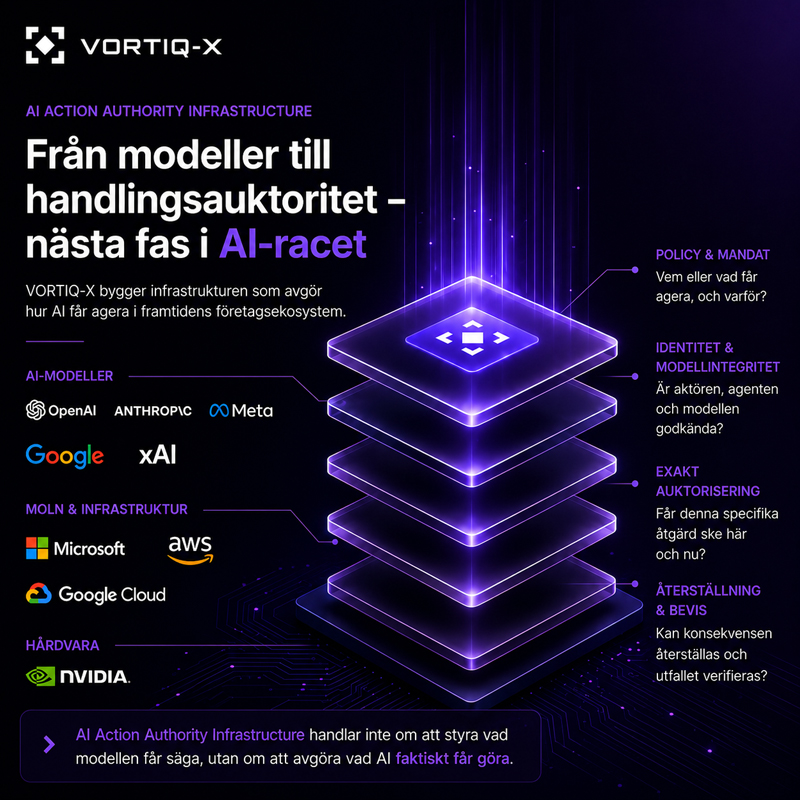
AI Action Authority Infrastructure is not about controlling what the model is allowed to say – but about determining what AI is actually allowed to do.
VORTIQ-X: from AI control to action authority
VORTIQ-X has built and verified the AI Action Authority Infrastructure – a self-contained execution layer between AI intent and mission-critical consequence. The layer determines before execution whether a precise AI-initiated action is allowed to read, move, modify, export, restore, or create a business commitment.
An AI model or agent may suggest an action, but cannot approve itself. VORTIQ-X binds identity, active mandate, model, tool, data scope, purpose, destination, jurisdiction, time, policy version, and recovery capability to a verifiable decision. The receiving system, at the same time, retains its own local veto power.
This distinguishes Action Authority from traditional AI governance. AI governance assesses whether an AI system is developed and managed responsibly. Action Authority determines whether the exact consequence is allowed to become reality. Policy thus becomes not just documentation or ex post facto control, but an executable condition at the very moment of action.
The repository is model-neutral and can remain under customer control even as models, agents, clouds, and tools change. This makes the model a suggestion engine, while identity, policy, authority, recovery, and evidence remain persistent parts of the operational infrastructure.
| Policy & mandate | Identity & model integrity |
|---|---|
| Who or what is allowed to act – and why?Verifies that the correct identity and mandate exist before an AI-initiated action can be performed. | Are the actor, agent and model approved?Ensures that identity, AI agent, and model are authenticated and trusted. |
| Exact authorization | Recovery & Proof |
| Can this specific action be taken here and now?Assesses the current action based on policy, purpose, data, destination and context. | Can the consequence be restored and the outcome verified?Every decision should be traceable, verifiable and, if necessary, reversible. |
Verified execution – not just a concept
The technology is not just an architectural concept. According to VORTIQ-X's registered R57 validation data, the accepted generation was run across eight distributed execution paths with true local model inference via DeepSeek 70B and Qwen 14B routes. The system performed 914 normal and 914 optimized regression runs, verified 136 out of 136 classification cases, and handled 368 real-time calls within an adversarial test program without any business consequences that were not allowed by policy.
| 8 | 914 + 914 | 136 / 136 | 0 |
|---|---|---|---|
| Distributed execution paths | Normal and optimized regression runs | Verified classification cases | Policy-improper operational consequences |
| Ensures distributed and resilient execution. | Comprehensive verification of functionality and stability. | All classification cases were successfully verified. | No unauthorized operational consequences were allowed to pass. |
The system was also tested for rollback and reactivation. The previously stable generation was rolled back, after which the accepted generation was successfully reactivated across all eight execution paths. This demonstrates that the control layer can not only make decisions, but also handle lifecycle, rollback, and stable redeployment.
In a five-arm architecture comparison, it produced full VXDGAF architecture 56 verified control outcomes, compared to 48 for the strongest baseline, while policy uncertainty outcomes decreased from 80 to zero. The 56 outcomes included correct approvals, transformations, hold decisions, blocks, restores and decisions not to release – not 56 commercial transactions.
The VECTRA-assisted path preserved the same 56 governance outcomes but avoided 72 out of 88 possible model calls by letting deterministic checks handle known cases first. This reduces the number of unnecessary model calls and thus the computational cost, latency, and exposure that these calls would otherwise create.
A persistent, model-neutral control layer
The expression “AI as infrastructure” is itself too broad. It could refer to cloud, data center, model operation, orchestration, or operational visibility. VORTIQ-X's position is more precise: the AI race is moving from model capacity to AI Action Authority Infrastructure – the persistent layer that determines which models are allowed to participate, how agents are allowed to be orchestrated, what data and tools they are allowed to use, whether a precise action is allowed to run, how recovery is ensured, and how the outcome is proven.
The models do not cease to be important. Instead, they become interchangeable suggestion engines under a customer-controlled layer where identity, policy, memory, authority, recovery, and evidence can persist. This reduces dependency on a single model vendor and allows the same rules of engagement to be maintained even as the underlying AI technology changes.
Action Authority is therefore not another model, agent framework, or ex post review dashboard. It is the checkpoint between intention and consequence – the place where a proposed AI action is either given a verifiable right to proceed or stopped before it becomes reality.
A shift that affects the entire AI ecosystem
The discussion in the All-In Podcast shows that models are still strategic, but the infrastructure around them is becoming just as crucial. Companies that combine advanced models with robust identity, precise authorization, local veto, recovery, and verifiable proof are better positioned to use AI in mission-critical processes.
For corporate buyers and decision-makers, this changes the audit. It is not enough to ask how intelligent the model is. The organization also needs to be able to show who or what acted, under what mandate, with what model and which tool, against what data, for what purpose and which destination, under which policy version – and whether the consistency can be restored. Without those answers, an operational risk remains regardless of the model’s benchmark results.
For VORTIQ-X The shift confirms that the next chapter in enterprise AI is not just about intelligence. It's about how intelligence can be connected to real action in a secure, controlled, and business-critical way.
| Policy and mandate | Identity and model integrity |
|---|---|
| Who or what is allowed to act, and under what mandate? Before an AI-initiated action can be carried out, the system must verify that the actor has the correct authorization and that the action is within applicable policy. | Are the actor, agent, and model verified and trusted? Every AI agent, model, and identity must be able to be authenticated before any mission-critical action is allowed. |
| Exact authorization | Recovery and verifiable proof |
| Can this specific action be carried out here and now? The decision is based on identity, purpose, data, destination, policy, and current context, not solely on the user's permissions. | Can the consequence be restored and can the decision be proven retrospectively?Every executed or blocked AI action should be verifiable, traceable and, if necessary, reversible. |
READ ALSO
AI Action Authority Infrastructure: why next-generation enterprise AI requires a new layer of action authority, identity, and precise authorization.
Immerse yourself in the VORTIQ-X AI Authority Benchmark: see how the platform verifies AI-initiated actions, guides model paths, reduces unnecessary model calls, and creates verifiable evidence before actions become reality. Read more: https://vortiqxconsilium.com/benchmark









 Swedish
 Danish
 Norwegian
 Finnish
 English
 German
 Dutch
Dutch