






Looking for a Shorter Overview?
AI Summary
Key Moments
AI drives faster attacks
Attackers are using AI to greatly increase the speed and scale of cyberattacks.The time to stop attacks is reduced
The median for further dissemination after initial access is now 29 minutes.The cloud and identities are the main targets
Cloud infrastructure and identities continue to be high-risk areas for attacks.AI systems are new attack surfaces
AI applications and models must be protected as critical infrastructure.Artificial intelligence is no longer just changing how businesses work, it is also changing how cybercriminals plan, execute and scale their attacks. According to CrowdStrike 2026 Global Threat Report AI has become one of the key drivers behind faster intrusions, more advanced social manipulation, and a shrinking window of time for defenders to detect and stop attacks.
Cyber threats are evolving at a pace few organizations have ever experienced. What used to take days or weeks can now be accomplished in minutes, while attackers are using generative AI to automate everything from reconnaissance and phishing to code development and intelligence gathering.
CrowdStrike describes the development as a paradigm shift where AI serves as both a powerful tool for defenders and an accelerating factor for attackers. The result is a threat landscape where speed, identities and cloud services are at the center. 





AI is driving a new generation of cyberattacks
One of the report's clearest conclusions is that threat actors using AI have significantly increased their activity. CrowdStrike recorded an increase of 89 percent of attacks from AI-powered attackers compared to the previous year. AI is used to improve social engineering, automate phishing campaigns, analyze targets and streamline malware development, among other things.
At the same time, the report points out that AI does not necessarily create entirely new attack methods. Instead, the technology makes existing attacks significantly faster, cheaper, and easier to scale.
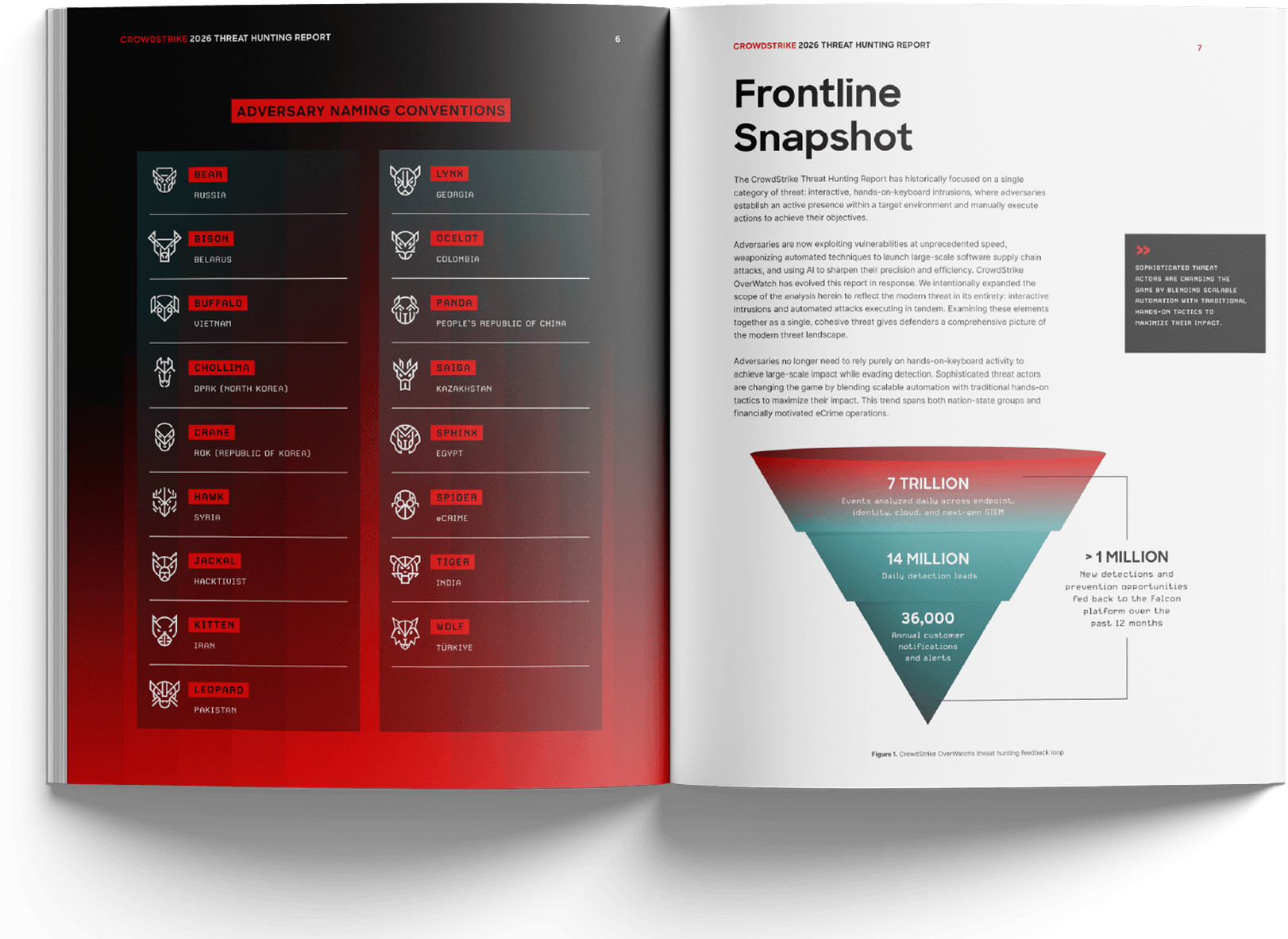
The time to stop an attack is getting shorter and shorter
Speed is one of the report's most notable observations.
CrowdStrike recorded the fastest so-called eCrime breakout time so far, only 27 seconds. The median speed at which attackers move from initial access to further spread in a compromised environment has also dropped to 29 minutes.
For security teams, this means that traditional working methods are no longer enough.
As attackers automate large parts of the attack chain, the opportunity for manual analysis and slow incident processes diminishes, forcing organizations to increasingly leverage automated security platforms, AI-based threat detection, and continuous monitoring.
AI is also becoming a new attack surface
The report shows that AI is not only being used as a tool for attackers, but that AI systems themselves are becoming attractive targets.
Companies are rapidly implementing generative AI services, AI agents, and language models that can handle business-critical information, internal documents, and automated workflows, making them a new type of attack surface.
CrowdStrike therefore warns that organizations need to protect both AI models, AI applications, identities and the underlying infrastructure in the same way as traditional IT systems.
More attacks are targeting the cloud
Cloud infrastructure continues to be a priority target for both cybercriminals and state-sponsored groups.
The report shows a 266 percent increase of cloud-targeted intrusions by state-linked threat actors. Attackers are increasingly leveraging stolen identities, misconfigurations, and trusted cloud services to move between environments without arousing suspicion.
At the same time, CrowdStrike notes that identity-based attacks continue to increase, which means that multi-factor authentication, privilege management, and continuous identity monitoring are becoming increasingly important.
Zero-day vulnerabilities continue to increase
Another area of concern for security experts is the development of zero-day vulnerabilities.
According to the report, the number of vulnerabilities exploited before being made public increased with 42 percent during the year. Attackers are also increasingly targeting edge devices and internet-exposed infrastructure where compromise can quickly provide access to the entire organization's network.
This means that companies need to reduce the time from detection to patching and work more proactively with risk management.
Security work must be done in real time
CrowdStrike believes that cyber defenses now need to work at the same speed as attackers.
It is no longer just about detecting malware, but about identifying anomalous behaviors, protecting identities, securing AI systems, and automating the response before an attacker has time to establish itself in the environment.
As AI continues to develop, the ability to combine human expertise with automated security analysis will become a crucial competitive advantage for both private and public organizations.
AI is changing the playing field
CrowdStrike’s report shows that AI has become a permanent part of the cyber threat landscape. The technology is already being used today to make attacks faster, more precise and harder to detect, while companies are increasingly building their businesses around AI-powered services.
For Swedish organizations, this development means that cybersecurity can no longer be seen as a separate IT issue. The protection of identities, cloud infrastructure and AI solutions needs to become an integrated part of the business's digital strategy.
When both attackers and defenders use AI, the crucial difference will not be in who has access to the technology, but in who can use it fastest and most effectively.

Download the report
Want to see the full analysis and CrowdStrike's latest threat insights? Download CrowdStrike Global Threat Report 2026 and access detailed statistics, analyses of threat actors, and recommendations for how organizations can strengthen their cyber defenses in a time where artificial intelligence is changing the threat landscape.
Download the report here:
https://www.crowdstrike.com/en-us/global-threat-report/




















 Swedish
  Danish
  Norwegian
  Finnish
  English
  German
  Dutch
Dutch