




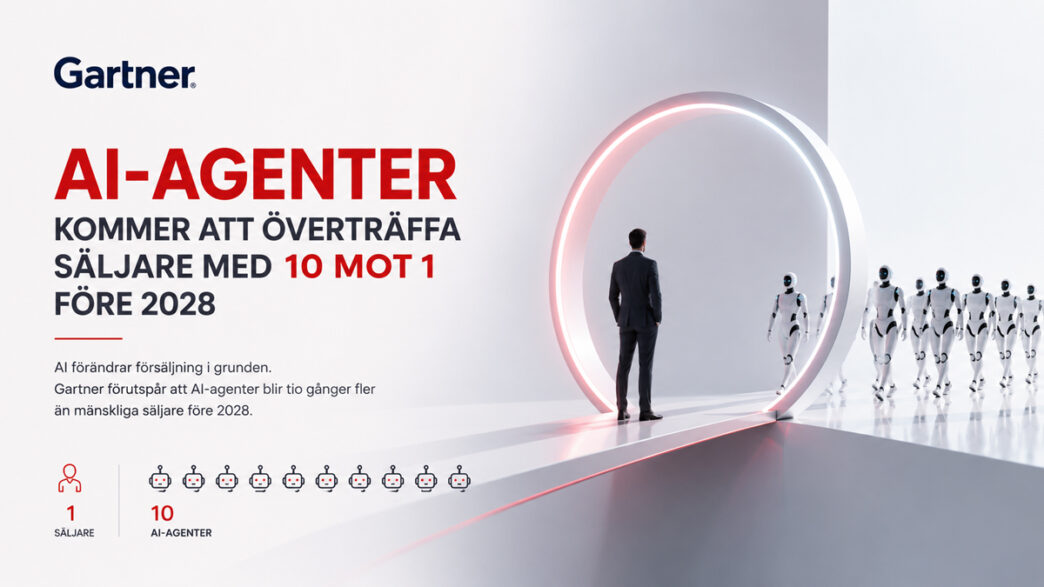

Artificial intelligence is rapidly changing sales and the development looks set to accelerate in the coming years. According to a new forecast from the research firm Gartner, AI agents to outnumber human salespeople by ten to one by 2028. At the same time, Gartner estimates that fewer than 40 percent of sellers will consider that AI agents have actually improved their productivity.
The forecast points to a future where companies increasingly use autonomous AI agents to automate sales tasks. Gartner also warns that many organizations risk creating an uncontrolled population of AI agents if they do not simultaneously modernize their data management, automation and user experience.
AI is changing the role of the salesperson
Gartner believes that AI agents will not primarily replace humans, but will change how sales organizations work. 



Instead of spending time on manual and repetitive tasks, salespeople will increasingly focus on strategic customer dialogues, relationship building and complex advice, while AI agents will handle, for example:
- Prospecting
- Lead qualification
- Customer surveys
- Meeting bookings
- Compilation of customer information
- Follow-ups and administrative tasks
This means that the salesperson's role evolves from administrator to advisor and business partner.
Productivity is not a given
Despite the rapid development, Gartner cautious about concluding that more AI agents automatically lead to higher productivity.
The research firm estimates that fewer than four in ten salespeople will find that AI agents make their work more efficient. One of the biggest challenges is that many companies are implementing AI solutions without first ensuring data quality, clear processes, or a well-thought-out user experience. The result is more systems, more complexity, and less efficiency, rather than the opposite.
Data quality becomes a crucial competitive factor
According to Gartner Success will not be determined by how many AI agents a company uses, but by how well they integrate with the business's data and workflows.
Organizations that invest in data quality, automation, and clear governance will be significantly better positioned to benefit from AI than companies that simply implement new AI tools.
AI agents become part of everyday business
The development reflects a broader trend where AI agents are rapidly establishing themselves in more and more business areas, from customer service and marketing to IT operations, cybersecurity and software development.
For sales organizations, this means that AI will increasingly act as a digital colleague that can analyze information, perform tasks, and provide decision support in real time. At the same time, human expertise will still be crucial when it comes to relationships, negotiations, and strategic business decisions.
Gartners The forecast highlights that the future of sales will likely be a combination of human expertise and AI-driven automation. Companies that manage to create a balance between technology, data, and human expertise are expected to gain the greatest competitive advantages in the coming years.











 Swedish
  Danish
  Norwegian
  Finnish
  English
  German
  Dutch
Dutch