




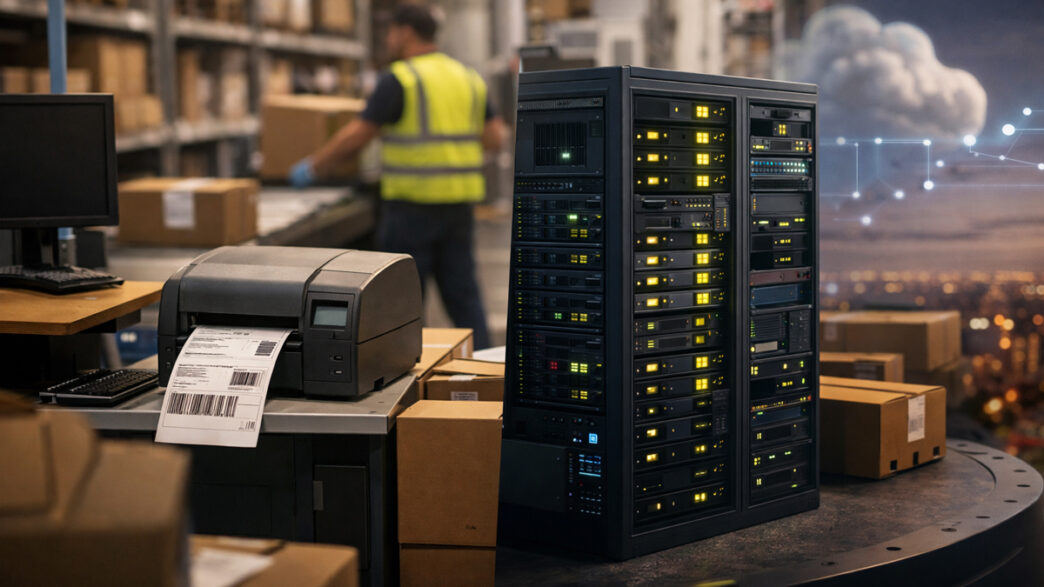
The need for local logistics operations is increasing, especially in warehouse and distribution environments.
For many years, the cloud has been seen as the obvious answer to almost all IT issues. Flexibility, scalability and central updates have made cloud services the standard in large parts of the business world. But in some businesses, a clear counter-movement is now noticeable. As logistics flows are digitized and the pace of supply chains increases, more and more companies are starting to see the value of local operations again, especially in systems where every second counts.
This applies not least to transport administration. In warehouses and distribution centers, this is where goods are booked, labels are printed and transports are registered. If something goes wrong at this stage, the entire delivery is affected, with the consequence of a delay providing a worse experience for the end customer.



“When a shipping label is not printed, logistics does not work. Then the flow stops quickly and it costs money immediately,” says Stefan Jorkander, CEO of Connect Companies.
When a few seconds make a difference
Cloud services work great in many contexts. But in systems that are close to operational operations, the reliance on external servers can create new challenges. In a warehouse where hundreds or thousands of orders are shipped every day, even small delays can have noticeable consequences.
If a label must first be generated in an external system before being sent back to the printer, the process can take a few seconds longer than when operating locally. For a single order, this is rarely crucial, but in a high-speed environment the effect can quickly become apparent.
“Many people think that a few seconds here or there doesn't matter. But in a warehouse where every order goes through the same steps, it can quickly become a bottleneck,” says Jörkander.
Security and dependencies affect strategy
It's not just performance that's driving the growing discussion about local operations. The cyberattacks and ransomware incidents of recent years have made many organizations more aware of how vulnerable central systems can be.
At the same time, geopolitical developments have made dependence on international cloud providers an issue even at the management level. When critical business processes are completely outsourced, the consequences are greater if something goes wrong.
“More companies are starting to ask themselves a fairly simple question. What happens to our inventory if the internet connection is lost or an external service is down? In some businesses, the answer is quite inconvenient,” says Jörkander.
Hybrid solutions are becoming increasingly common
This does not mean that the cloud is going away. On the contrary, most companies continue to use cloud services to a large extent. However, there is growing interest in hybrid solutions where some functions run locally while others are in the cloud.
Systems that are close to the actual production or logistics are often candidates for local operation.
An example is Star Trading, where the stability of the transport flow was an important factor when reviewing their solutions.
– During peak season, the TA system is a critical success factor. With the new Blue TA service, we have both streamlined and scaled up our handling without increasing costs. Above all, we have gained a completely different stability in deliveries, says Mattias Callin at Star Trading.
Technology must follow the business
Companies working with integration solutions in logistics believe that the discussion sometimes ends up in the wrong place. The question is not about choosing a side between cloud and on-premises operations, but about starting from the needs of the business.
“There is no intrinsic value in having everything in the cloud. The best solution is the one that makes the business function stably every day,” says Jörkander.
In some environments, this means that parts of the infrastructure need to be closer to the actual operations. Transport administration is a clear example.
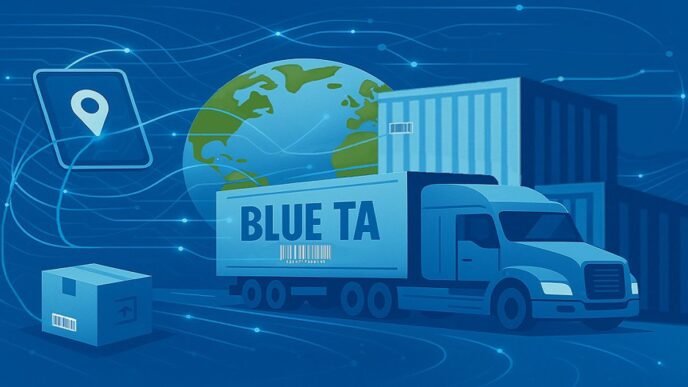
Platforms like Blue Integrator, together with transport management solutions such as Blue TA, are therefore designed to run both on-premises and in the cloud, allowing companies to choose the operating model that best suits their business.
A more nuanced conversation about the cloud
The cloud will continue to play a central role in companies' IT strategies. But developments show that more organizations are starting to make more nuanced assessments of where different systems belong.
In businesses where logistics are business-critical, local operations can once again become an important part of the infrastructure.
– For many years, the discussion was about moving everything to the cloud. Now more people are starting to realize that the important thing is not where the systems are located, but that they work when the business needs them, concludes Stefan Jorkander.









 Swedish
 Danish
 Norwegian
 Finnish
 English
 German
 Dutch
Dutch