


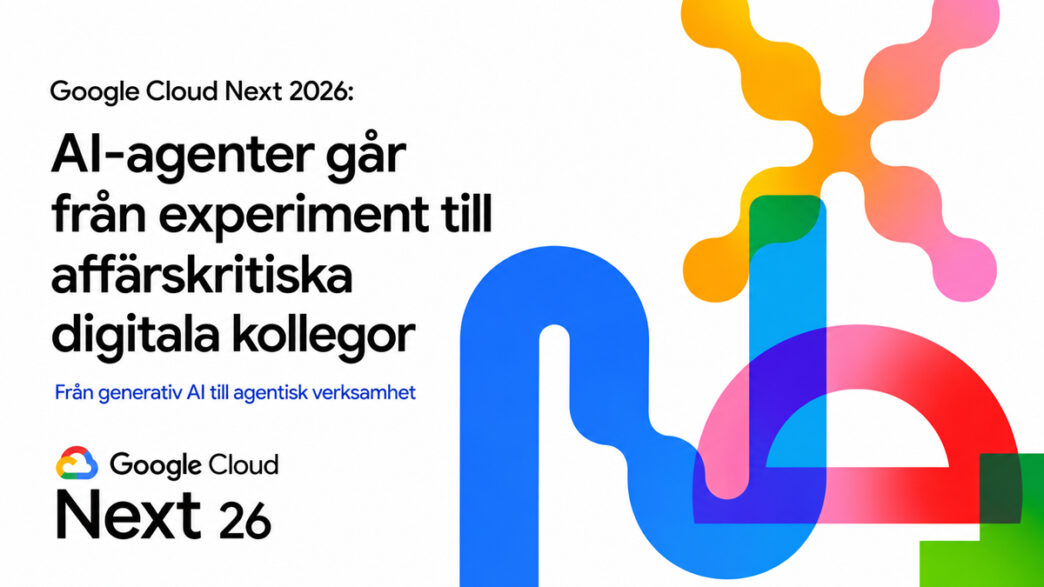
LAS VEGAS – Google Cloud Next 2026 was yet another demonstration that AI development is entering a new phase. While the past two years have been dominated by generative AI and chat-based assistants, this year’s big message was clear: the future is about AI agents.
During the conference, Google presented its vision for the agentic business, where intelligent AI agents don't just answer questions or generate content, but actively perform tasks, make decisions, analyze information, and collaborate with people to drive business results.
The message from Google's leadership was clear. AI is no longer an experiment or a pilot project. AI is becoming an integral part of companies' daily operations.

From Generative AI to Agentic AI
When generative AI took hold, it changed the way people worked with information. Tools like Gemini, ChatGPT, and other AI assistants made it possible to create texts, summarize documents, analyze data, and write code in seconds.
The next step is about moving from generating content to performing work.
Google describes this development as Agentic AI, where AI systems can understand goals, plan activities, use tools, retrieve information from various data sources, and complete tasks with limited human intervention.
This means that an AI agent can, for example, handle customer inquiries, compile reports, analyze business data, automate administrative processes, and collaborate with other AI agents to solve complex problems.
Google believes that this will fundamentally change how organizations work in the coming years.
Agentic Data Cloud will connect data and action
One of the biggest initiatives presented during the conference was Agentic Data Cloud.
Many companies today have large amounts of data scattered across different systems, databases, cloud platforms and business applications. The challenge has long been to make this information accessible and usable for AI.
With Agentic Data Cloud, Google wants to create a platform where AI agents can access the right data at the right time while maintaining security, compliance, and data governance.
Google describes the solution as a combination of data management, analytics, AI models and automation that makes it possible to move from insights to action significantly faster than before.
For businesses, this means that AI agents can act on current business information instead of relying solely on historical data.
Gemini becomes the hub of the company's AI strategy
Gemini continues to be at the center of Google's AI effort.
During Google Cloud Next Several new features for the Gemini platform were introduced, focusing on enterprises, developers and mission-critical use cases.
The goal is to enable organizations to build their own AI agents that are tailored to specific business needs.
Google envisions that within the next few years, companies will use hundreds or even thousands of AI agents working in parallel with employees.
These agents can serve as digital specialists in customer service, finance, HR, IT support, marketing, sales, legal, and software development.
AI is already changing how Google works
Google also highlighted its own experiences using AI internally.
According to the company, around 75 percent of all new code developed today is supported by AI during the development process.
It's not about replacing developers, but about making them more productive by automating repetitive tasks, identifying errors faster, and providing recommendations in real time.
Similar developments are now being seen in more areas where AI is being used to support knowledge workers, analysts, support staff and business developers.
Security and governance become crucial
As AI agents gain greater responsibility, demands on governance and security increase.
Google therefore introduced several new features for monitoring, identity management, policy controls, and risk management.
For many organizations, this is a critical issue. If AI agents are to be able to make decisions, access business-critical information, and perform tasks, clear mechanisms for control, traceability, and compliance are required.
Google emphasizes that future AI platforms must be built with security as a fundamental principle rather than an add-on.
What does this mean for Swedish companies?
For Swedish companies, the message from Google Cloud Next 2026 is clear.
The first wave of AI was about experimenting with new tools. The second wave is about integrating AI into business. The third wave is about creating digital workers who can do real work.
Organizations that successfully combine their data resources with AI agents will likely be able to automate processes, improve customer experiences, and make faster decisions than their competitors.
At the same time, development requires new skills, new governance models and a clear strategy for how AI should be used responsibly.
The workplace of the future is taking shape now
Google Cloud Next 2026 shows that AI agents are no longer a future scenario. They are on their way to becoming a natural part of companies' daily operations.
For business leaders, the challenge is no longer about understanding what AI is. The focus is now shifting to how the technology can be implemented, managed, and scaled to create real business value.
The question is no longer whether companies will use AI agents.
The question is how quickly they can start creating value with them.







 Swedish
 Danish
 Norwegian
 Finnish
 English
 German
 Dutch
Dutch