



Looking for a Shorter Overview?
AI Summary
Key Moments
Unified platform for security
Cisco Cloud Control brings together networking, security, and collaboration in a common environment where humans and AI agents work together.Rapid response to AI-related threats
The explosive growth of AI requires faster and more proactive security measures, which Cloud Control enables.Adaptable and trusted AI agents
Operators can use autonomous agents that identify, remediate, and test changes under secure conditions.Development and integration in Studio
Customers can build their own AI agents and apps in Cloud Control Studio, supported by a broad ecosystem of third-party platforms.Cisco has created a unified security platform where humans and AI agents work together to operate and protect critical infrastructure. The new platform, Cisco Cloud Control, was unveiled at the Cisco Live in Las Vegas.
The explosive growth of AI – both in use and capabilities – places new demands on IT organizations’ ability to act and respond to external threats and disruptions. Reactive defense is no longer enough as the time between a vulnerability being discovered and being exploited has shrunk from weeks to minutes.
Through initiatives such as Anthropic's Project Glasswing and OpenAI's Daybreak, Cisco is deeply involved in the work of analyzing and evaluating the threats of the new AI era - and in creating new solutions that can address them.



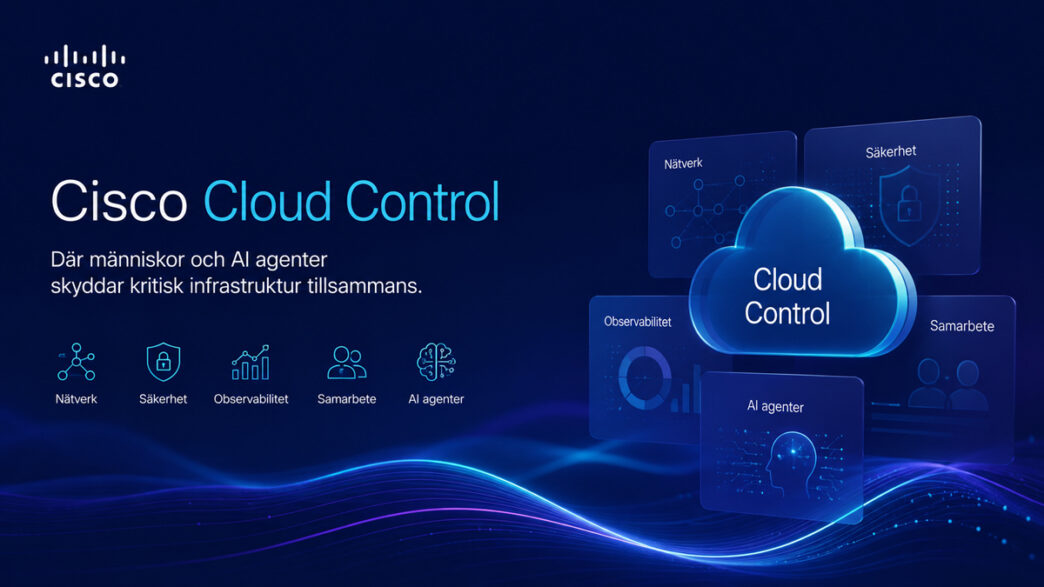
With Cisco Cloud Control, organizations gain instant visibility into their networks, security, computing, observability, and collaboration in a unified, secure environment. People and agents work in the same data store, in the same context, and with the same system of action. Customers can build their own agents and applications directly on the platform, which is also integrated with a large ecosystem of partners, including Amazon Web Services, Linear, ServiceNow, and Slack.
”Cisco Cloud Control is a command center for agentic AI; a platform where your employees and your AI agents work together, in the same environment, with the same information, and where people are in control,”, says Jeetu Patel, President and Chief Product Officer at Cisco.

Among the capabilities of Cisco Cloud Control are:
Cross-domain telemetry. The data flow across networks, security, observability, and collaboration platforms is brought together in Cloud Control so that people and agents can act on the same information to address business-critical requirements.
Custom-built models. Cloud Control reasons through complex problems with the right mix of purpose-built and general-purpose models—including Cisco’s Deep Network Model, based on 40 years of experience and network data. The result is system intelligence that scales with the complexity of the problem, not just the size of the model.
Trusted agents. Through Cisco Cloud Control, operators will be able to work with autonomous agents that can follow a structured path to action: detect issues, identify causes, perform remediation, test changes before deployment, and secure the user experience. These agents will be powered by Cisco telemetry and purpose-built models, and they will leverage other capabilities such as Expanded Experience Metrics, Deep Reasoning, Digital Twin, and Cisco Agentic Workflows. Teams will be able to automate network operations with an agent loop, while maintaining visibility and control over actions.
Cisco AI Canvas. A generative shared workspace where operators and agents work from the same information to investigate and solve complex problems together in real time, where context is maintained as new shift workers take over or cases escalate.
Cloud Control Studio. The design space unlocks two customization environments: Agent Builder lets customers build Cloud Control agents tailored to their own policies and workflows. They can connect to more than 50 third-party platforms and tools through built-in connectors or the open Model Context Protocol (MCP). App Builder lets customers build and publish Cloud Control apps and workflows from natural language, with the OpenAI Codex agent coding assistant built in. Anything built in Studio—plus agents and apps from across the Cisco ecosystem—can be published to the Cloud Control Marketplace.
The platform is already available today to a limited group of users for evaluation purposes, and will become generally available later in 2026.



















 Swedish
 Danish
 Norwegian
 Finnish
 English
 German
 Dutch
Dutch