




Looking for a Shorter Overview?
AI Summary
Key Moments
DLSS usage among RTX gamers
More than 80% of RTX gamers enable DLSS with three billion hours of gameplay with the technology.DLSS's evolution since 2018
DLSS has gone from a challenging start to being available in over 540 games and popular with gamers.Innovations in DLSS 4
New neural architecture in DLSS 4 improves upscaling, stability, and latency for a better gaming experience.Flip metering for better frame pacing
Nvidia's new technology to reduce judder and improve game smoothness via a revamped display engine.To no one's surprise, Nvidia is going full AI and placing DLSS in the middle of their RTX 50 graphics card. Controversy over false frames aside, it turns out the AI-based upscaler is actually already quite popular, as Team Green claims that most of its user base is already taking advantage of the one-click frame rate booster.
DLSS usage is growing among RTX gamers
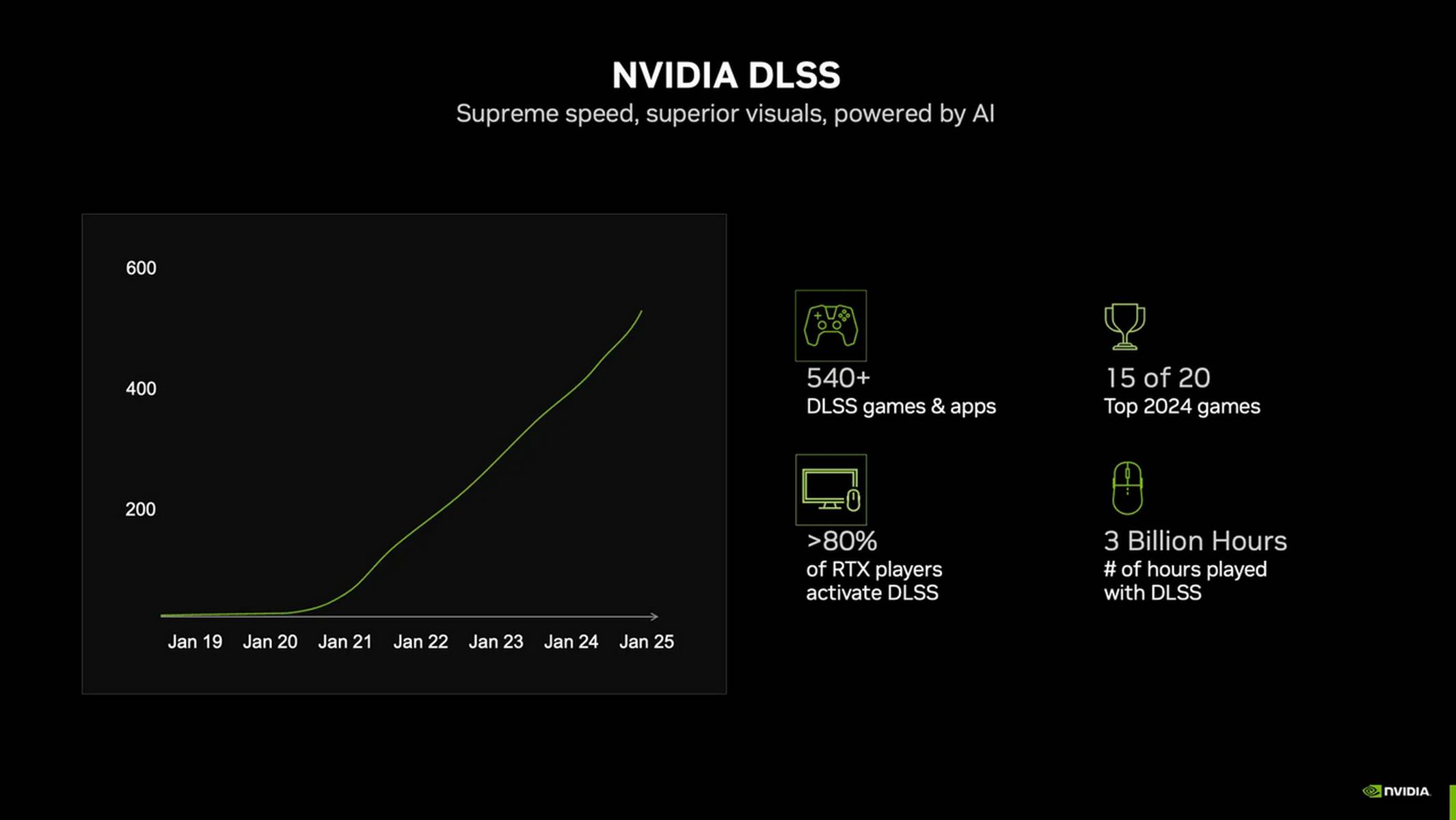
The brand shared an interesting image claiming that more than 80% of RTX players are activating DLSSTogether, they account for three billion cumulative hours of DLSS-enabled gameplay. An impressive feat that makes us wonder how AMD's FSR will fare in this regard, given that it's a more open and hardware-agnostic solution.
How Nvidia counts its DLSS users
Even if Nvidia didn't give much detail on how it got that percentage, which isn't surprising. From the looks of it, everyone has tried DLSS at least once. And since many gamers play more than one title, chances are at least one required a small frame rate boost, thanks to a good old AI accelerator. Now imagine if GTX cards also had access to DLSS instead of FSR and XeSS (XeSS details), these numbers could be impressive. 





DLSS has been constantly evolving since 2018
DLSS, which was introduced back in 2018 alongside the RTX 20 series (history), did not stop developing. From a slow start that required AI training per game to the difficulty of convincing developers to adopt it, not to mention the reluctance of players to use it, DLSS has come a long way to reach its current state. At the time of writing, it is available in more than 540 games and apps (list of DLSS games) – including 15 of the top 20 games of 2024 according to Nvidia. DLSS has become inevitable.
DLSS 4 and next-generation innovations
Its latest version, DLSS 4, takes Nvidia's ambitions even further by fine-tuning upscaling quality, stability, and latency, in addition to a new multi-frame generation solution that takes game smoothness to new heights. These new advances are made possible by a completely new neural architecture for the first time since DLSS 2 (technical details).
Flip measurement: Another key feature
And these are just the ones directly related to DLSS. Another feature thanks to a revamped display engine is what Nvidia calls flip metering (official information). This technology should help the GPU deliver consistent and optimal frame-pacing, making games feel smoother by reducing judder caused by inconsistent frame-timing.
The future of scaling is here
Of course, DLSS – and upscaling in general – is here to stay. And with the improvements we see with each passing generation, we don’t mind it all that much as long as it doesn’t affect actual game optimization. The next step is to push image generation to the same level as DLSS upscaling to make it acceptable to have 15 out of 16 AI-generated pixels (future of AI rendering).



















 Swedish
  Danish
  Norwegian
  Finnish
  English
  German
  Dutch
Dutch