



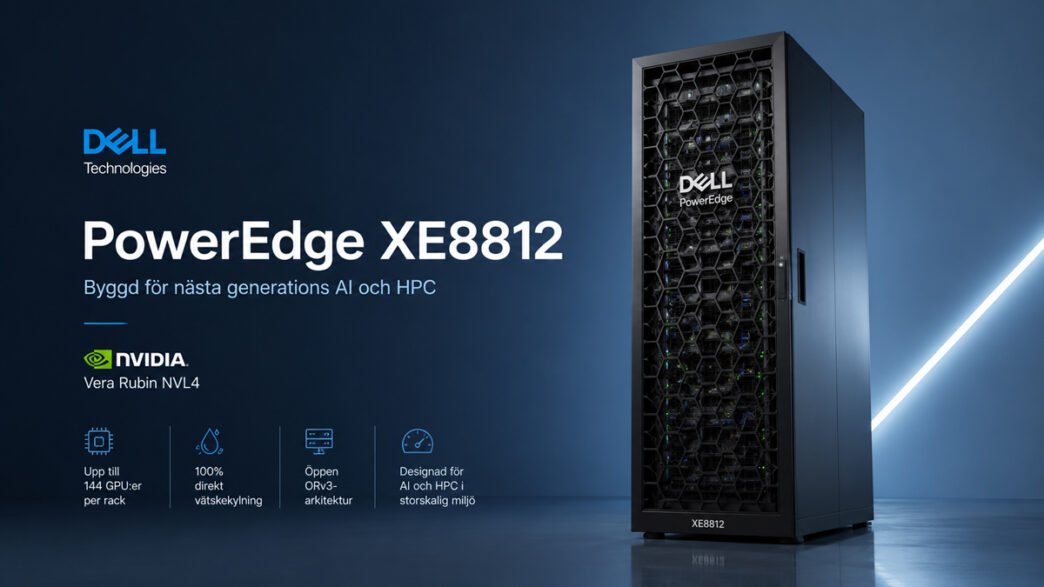
The new Dell PowerEdge XE8812 fanless, direct liquid-cooled server with NVIDIA Vera Rubin NVL4 architecture is designed for the most demanding AI and HPC workloads. Scalable up to 144 GPUs per rack, the platform is designed to meet the rapidly growing demand for compute power for artificial intelligence, simulations, and scientific research.
Organizations around the world are investing in ever-larger AI models and advanced simulations. At the same time, AI and High Performance Computing (HPC), which places entirely new demands on data center infrastructure. To be able to translate AI strategies into practical results, platforms are required that combine extreme computing power, high memory bandwidth, and energy-efficient cooling.
In response to these needs, presents Dell Technologies now PowerEdge XE8812, a new generation AI server that will become part of Dell AI Factory with NVIDIA. The server is built on the new NVIDIA Vera Rubin NVL4 architecture and is designed to deliver significantly higher performance for both AI training, inference and advanced HPC workloads.


Built for large-scale AI and HPC
The Dell PowerEdge XE8812 targets organizations working on some of the world's most compute-intensive workloads, such as molecular simulations, multiphysics, climate models, drug development and generative AI.
The fanless design uses 100 percent direct liquid cooling for both processors and GPUs, enabling significantly higher component density while keeping power consumption low even under extreme loads.
NVIDIA Vera Rubin delivers a generational boost
With the transition from NVIDIA GB200 NVL4 to NVIDIA Vera Rubin NVL4, the PowerEdge XE8812 receives a clear performance boost.
The new platform offers:
- More CPU cores, from 144 to 176.
- Significantly larger host memory.
- More GPU memory.
- Higher total computing capacity.
Combined with the NVIDIA CUDA-X libraries, organizations can run significantly larger AI models and HPC simulations entirely in memory, reducing bottlenecks and significantly improving performance.
Up to 144 GPUs per rack
The PowerEdge XE8812 is designed for maximum compute density.
Among the most important features are:
- Up to 144 GPUs per rack.
- Over 300kW current capacity.
- 100 percent direct liquid cooling.
- ORv3-based rack design with open architecture.
The high density makes it possible to deliver significantly more AI performance within the same data center space, while optimizing cooling and energy usage.
Larger memory for larger AI models
One of the biggest improvements compared to the previous generation is the greatly increased memory capacity.
Dell states that the platform offers around 50 percent more memory per processor socket and GPU than the previous generation. This makes it possible to keep significantly larger language models, AI models, and scientific simulations entirely in working memory, reducing the need for data movement and providing higher performance.
Open architecture and simpler operation
The server is based on the open ORv3 standard, which provides a modular rack design that simplifies both installation and future upgrades.
Partl complements the platform with integrated system management tools that will reduce operational complexity, improve stability, and simplify the administration of large AI clusters.
Shorter path to production
For organizations building large AI and HPC environments, Dell also offers factory-integrated and pre-validated rack solutions.
By delivering pre-configured systems, implementation time can be shortened while reducing risk during deployment. The goal is to help companies and research institutions get into production faster and realize business benefits and returns on their AI investments earlier.
AI infrastructure is becoming increasingly crucial
The launch of Dell PowerEdge XE8812 shows how quickly the AI infrastructure market is evolving. As AI models continue to grow in size and complexity, performance, memory capacity, energy efficiency, and rack density are becoming increasingly important factors for the data center of the future.
Featuring the NVIDIA Vera Rubin NVL4 architecture, the Dell PowerEdge XE8812 positions itself as a platform for next-generation AI factories, scientific computing, and large-scale HPC environments where maximum computing power and efficiency are critical.











 Swedish
 Danish
 Norwegian
 Finnish
 English
 German
 Dutch
Dutch