


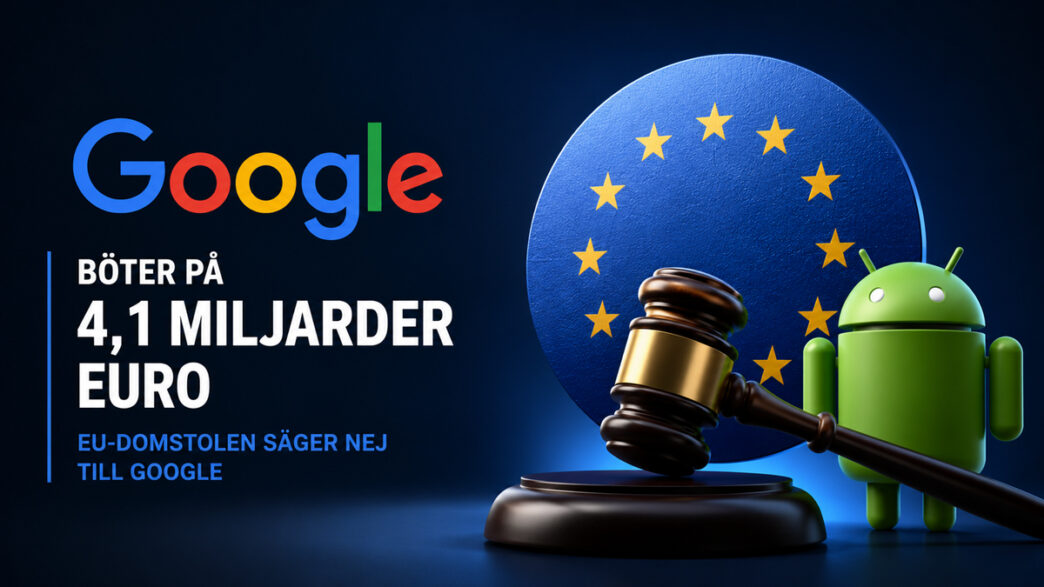

The European Court of Justice has finally rejected Google's appeal against the European Commission's antitrust decision relating to Android, upholding the fine of around €4.1 billion and ending a legal process that has been ongoing since the Commission's original decision in 2018.
The case concerns how Google used Android to strengthen its position in internet search and browsers by linking several of its services to the operating system.
Commission criticism of Google's Android deal
When the European Commission made its decision in 2018, it found that Google had abused its dominant market position through several contractual terms that restricted competition. 


The Commission pointed in particular to three key methods:
- Requirement that mobile manufacturers pre-install Google Search and Chrome to obtain a license to Google Play Store.
- So-called anti-fragmentation agreements that prevented manufacturers from selling devices with Android versions not approved by Google.
- Revenue sharing agreement where financial compensation was linked to exclusive pre-installation of Google Search.
According to the Commission, these conditions contributed to strengthening Google's already dominant position on the market for mobile search services.
The fine was reduced but the decision stood.
In 2022, the case was tried by General Court of the EU. Court of Justice annulled parts of the Commission's assessment of certain revenue-sharing agreements, which led to the fine being reduced from 4.34 billion euros to 4.125 billion euros.
At the same time, the General Court upheld the main part of the Commission's conclusions and held that Google had restricted competition through its Android agreements.
Google then chose to appeal the ruling to the European Court of Justice.

The European Court of Justice rules in favour of the Commission
In the final judgment, the Court of Justice of the European Union finds that the General Court made a correct legal assessment.
The Court considers, among other things, that:
- Google's Android agreement had anti-competitive effects.
- The General Court did not need to carry out a counterfactual analysis in each individual case to establish an abuse of a dominant position.
- The pre-installation requirements and anti-fragmentation agreements limited competition within the Android ecosystem and strengthened Google's market position.
This means Google's last opportunity to have the decision changed is denied.
Google: Android has always been about freedom of choice
Google emphasizes that Android is an open and free platform that gives users and manufacturers great choices.
In a statement, the company says:
“Android provides more choice for everyone and supports thousands of businesses. This ruling does not take into account our significant investment in ensuring Android remains open, interoperable, and free. We adjusted our agreements following the 2018 ruling and continue to focus on innovation and transparency for users, partners, and developers.”
Google also emphasizes that since 2018, the company has changed its contractual terms to comply with EU requirements.
Adaptations after DMA
The company states that it has implemented extensive changes in recent years.
Among other things, Google highlights:
- Revised license and distribution agreements following the 2018 decision.
- More choices for users starting in 2021.
- Over 20 product changes after Digital Markets Act (DMA) began to be implemented in 2024, including more choice screens for search engines and browsers.
At the same time, Google believes that the European Commission is underestimating competition from Apple iOS, which the company describes as Android's main competitor among both consumers and developers.
The company also emphasizes that Android manufacturers compete intensely with each other through innovation, functionality and pricing.
A guiding decision for Europe's technology market
The ruling will set an important precedent for how the EU views competition within digital platforms and reinforces the Union's line that large technology companies may not use their market position to restrict competition.
The decision also comes at a time when Digital Markets Act and other European regulations give regulators significantly greater opportunities to scrutinize the business models of the largest technology platforms.
For Google, the ruling means that one of the most extensive competition law cases in the company's history has now been definitively concluded, while also highlighting that the EU continues to set high standards for open competition in the digital economy.











 Swedish
  Danish
  Norwegian
  Finnish
  English
  German
  Dutch
Dutch