

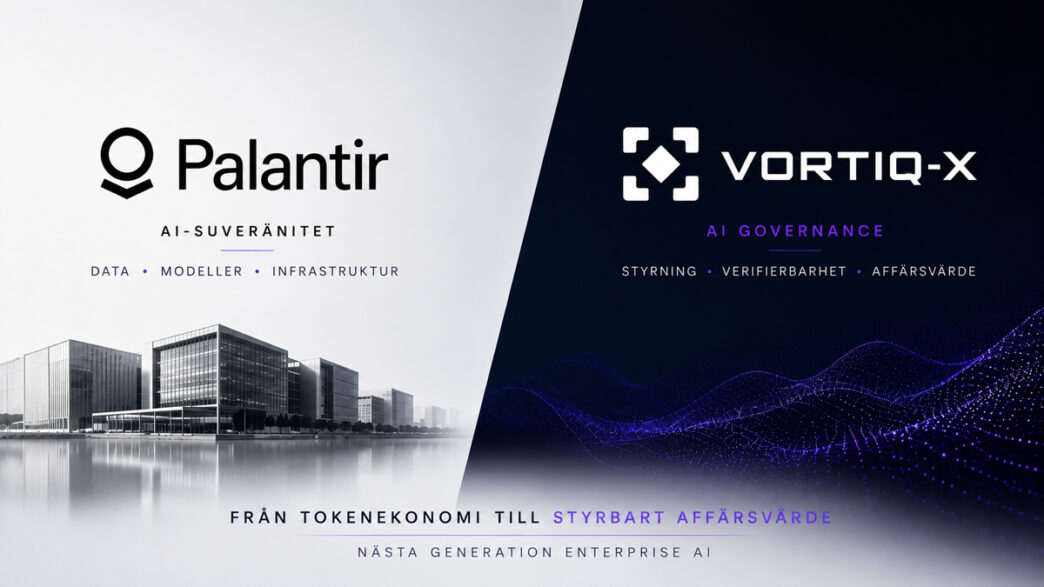

Palantir and VORTIQ-X illustrate how Enterprise AI is entering a new phase of development where governance, AI Governance, and verifiable business value are becoming more important than the number of tokens. As generative AI becomes an increasingly central part of business-critical operations, it is no longer enough to measure success in terms of the number of AI calls or computational capacity. The focus is instead shifting towards control, verifiability, and the business value that AI actually creates.
The crucial question is therefore no longer how many tokens a model generates or how many inferences it can perform per second. The question that more and more business leaders, CIOs and AI managers are now asking is much more business-critical:
What verifiable value did AI actually create?



That’s the premise of a new analysis paper from VORTIQ-X, which argues that the next phase of Enterprise AI is about governance, verifiability, and measurable business value, rather than just larger models and higher compute capacity. The report also illustrates how Palantir’s strategy around AI sovereignty and VORTIQ-X’s focus on AI Governance together reflect a larger shift now emerging in the enterprise market.
AI moves from experiment to mission-critical infrastructure
Over the past two years, the AI industry has been dominated by record investments in GPU clusters, language models, and AI services. At the same time, the use of generative AI has exploded in everything from customer service and software development to cybersecurity and decision support.
But when AI begins to impact business-critical processes, it is no longer enough to measure success in terms of token or model invocation counts.
For modern organizations, the new reality is about completely different issues.
- Did the AI decision create real business value?
- Could the decision be verified afterwards?
- Was the AI call really necessary?
- Was the right authorization found before AI was allowed to act?
- Can the organization show why the AI made a certain decision?
These are questions that are becoming increasingly important as AI moves from a productivity tool to an integrated part of core business processes.
Palantir is driving the development towards AI sovereignty
One of the players that has most clearly raised these issues is Palantir.
Over the past year, the company has emphasized the importance of organizations owning their data, models, model weights, compute capacity, and mission-critical expertise. The strategy is about AI sovereignty, where companies do not become dependent on external AI platforms but retain control over the entire technical and operational AI stack.
This is seen, among other things, in Palantir's investments together with NVIDIA around superior AI environments for authorities and critical infrastructure, where the focus is on secure AI operation and local control over data and models.
VORTIQ-X takes the next step: control over the AI decisions themselves
If Palantir focuses on who controls the AI infrastructure, VORTIQ-X seeks to answer the next big question:
Which AI decisions are actually worth implementing?
This is where the report's reasoning becomes particularly interesting.
Instead of simply optimizing models or reducing the cost per token, VORTIQ-X introduces a governance layer that evaluates each AI call before it is allowed to impact the business.
The system analyzes, among other things:
- competence
- evidence
- data sovereignty
- model protection
- recoverability
- impact analysis
Depending on the outcome, an AI call can be approved, stopped, quarantined, or saved for later review.
This means that the focus shifts from how much AI is running to how much controllable value AI actually produces.
From Token Economy to Governed AI Yield
Perhaps the report's most interesting contribution is the introduction of the concept Governed Token Yield.
Traditionally, the AI industry has used token counts, inferences, or GPU hours as measures of activity.
VORTIQ-X argues that these metrics say very little about the real business benefit.
Instead, the company proposes a new way to measure AI:
How many useful, authorized, and verifiable results were produced per token?
It is a shift in perspective that can have great significance.
If this model gains traction, it means that future AI investments will no longer be evaluated based on how much AI is running, but rather how much controllable and verifiable business value each AI effort actually generates.
Benchmark data that will move the discussion from theory to evidence
To support the reasoning, the report presents extensive benchmark material.
According to the document, the validation corpus includes, among other things:
- over 10.5 million extracted performance rows
- just over 10 million verified evidence records
- 2 115 analyzed documents
- 368 validation groups
- more than 138 billion tokens avoided
- over 782,000 AI calls avoided
The report also describes that no unauthorized controls or protection mechanisms could be bypassed during validation and that the AI work can be both verified and reproduced afterwards. These results are presented as the vendor's own benchmark and validation data.
More than cost savings
It would be easy to interpret the report as yet another argument for reducing AI costs.
But the message is much broader.
VORTIQ-X describes how every AI decision can be linked to governance, evidence and operational control before the model is allowed to perform a task.
This means that AI will not only be cheaper to use but also easier to audit, safer to deploy, and more predictable in mission-critical environments.
This is close to the requirements many organizations are already working with in cybersecurity, identity management and regulatory compliance.
AI Governance will be the next big competitive advantage
The development is not unique to VORTIQ-X.
The entire market is moving towards AI Governance, AI Security, AI Observability and AI Trust. Microsoft is developing governance capabilities for Copilot, Google Cloud is strengthening its AI controls, Anthropic is focusing on safe and responsible AI and NVIDIA is building infrastructures where organizations can control their own AI environments.
It is against this background that VORTIQ-X positions its technology.
Instead of competing for larger language models or faster inference, the company focuses on the layer that determines whether AI should be allowed to act at all.
It's a position that becomes increasingly relevant as AI moves from pilot projects to mission-critical environments.
AI Act reinforces the need for controllable AI
At the same time, the regulatory landscape is changing.
EU AI Act means that AI systems must increasingly be traceable, explainable and controllable.
For European organizations, AI is therefore not only about innovation but also about:
- transparency
- responsibility
- traceability
- risk management
- digital sovereignty
- verifiability
In this context, the report's reasoning becomes particularly relevant.
If AI systems need to be auditable, it is no longer enough to know which model was used. The organization also needs to be able to demonstrate why an AI decision was made, what the basis was for the decision, and whether the decision followed the company’s own policies and regulatory requirements.
Same goal but different layers
One of the report's most interesting conclusions is that Palantir and VORTIQ-X are not described as competitors.
On the contrary, the document illustrates how they address different layers of the same challenge.
Palantir focuses on control over:
- data
- models
- computing capacity
- AI sovereignty
VORTIQ-X focuses on control over:
- AI call
- decision-making basis
- verifiability
- consequences
- model protection
- controlled AI return
Palantir addresses the infrastructure.
VORTIQ-X addresses the decision layer on top of the infrastructure.
Together, they illustrate how Enterprise AI evolves from a technical platform to a complete governance system where control, security, and business value become as important as the performance of the models.
VORTIQ-X Positions itself as the Next Generation of Enterprise AI Governance
The most interesting thing about the report is perhaps not the benchmark results themselves, but how VORTIQ-X positions its technology.
The company is not trying to replace large language models, GPU platforms, or established AI ecosystems.
Instead VORTIQ-X positions itself as a governance layer on top of existing AI infrastructure where the task is to ensure that only authorized, verifiable and commercially motivated AI decisions have an impact.
This is also where VORTIQ-X positions itself as one of the first players to define the next generation of Enterprise AI Governance. Rather than competing for larger language models or faster inference, the company focuses on the layer that determines whether AI is allowed to act at all. It’s a perspective that is becoming increasingly important as AI moves from experimentation to mission-critical infrastructure.
IT Industry Analysis
Over the past two years, the AI market has been dominated by a race to bigger models, more GPUs, and higher performance. The next competitive advantage looks to be about control, governance, and verifiable business value.
It is here VORTIQ-X trying to define a new category.
If Palantir represents control over data, models, and AI infrastructure, VORTIQ-X seeks to define the next step: control over the AI decisions themselves. It’s not just about who owns the models, but about which AI calls are actually executed, which can be proven in retrospect, and which should never have been made.
About it development now driven by AI Governance, AI Act and increased demands for digital sovereignty continue to suggest that governance platforms will become as self-evident in AI environments as firewalls, identity management, and SIEM platforms are in cybersecurity today.
VORTIQ-X clearly positions itself for that development by shifting the focus from how much AI is used to what verifiable business value AI actually delivers.
As AI becomes an integral part of business-critical processes, organizations will likely need more than powerful models. They will need to be able to govern, measure, and prove every AI decision.
If the market develops in the direction that both Palantir and VORTIQ-X describes, the next big competitive advantage in Enterprise AI could be the ability to combine powerful models with full control, transparency, and verifiable business value. This would represent a clear shift from today’s token economy to an AI economy where quality, governance, and trust become the most important measures of success.











 Swedish
 Danish
 Norwegian
 Finnish
 English
 German
 Dutch
Dutch