

MiniMax released the weights for its MiniMax M2.7 model on April 12, 2023, amid a wave of open weight releases from Chinese labs, significantly impacting the competitive AI landscape.
This release is in line with a broader trend in China, as companies rush to showcase their progress. First announced in March, MiniMax M2.7 scored 56.22 % on the SWE-Pro benchmark, matching the results of GPT-5.3-Codex. It also scored 55.6 % on the VIBE-Pro benchmark, which is almost on par with Opus 4.6 for project delivery across web, mobile, and simulation tasks. The model also achieved the highest ELO score of 1,495 on the GDPval-AA assessment among open source models.
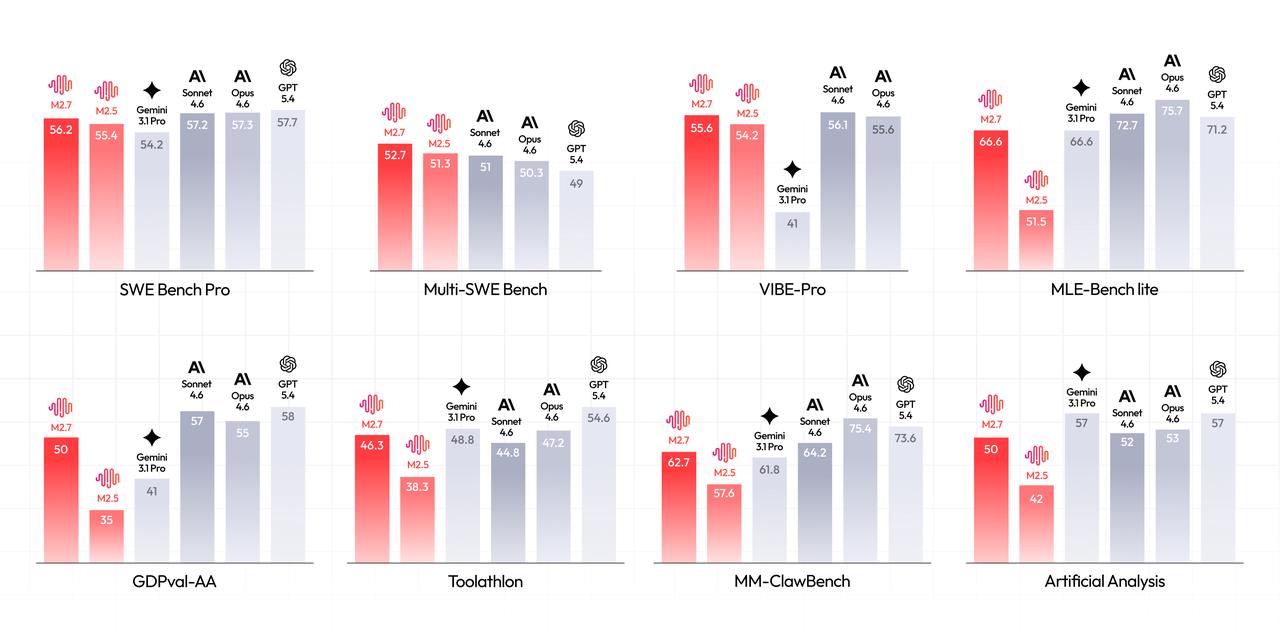
The weights for MiniMax M2.7 is now available on Hugging Face and is supported on NVIDIA platforms. However, the release has been criticized due to licensing restrictions that prohibit commercial use without prior written permission, which some community members believe undermines its open source classification. MiniMax characterized the M2.7 as the first model to participate in its own development cycle through a process they call “self-development.”. 


MiniMax launch follows Zhipu AI's open-sourced version of its GLM-5.1 model on April 7, which is licensed under the MIT license. This model, which contains 754 billion parameters, can perform engineering tasks autonomously for up to eight hours.
Conversely, Alibaba launched its own API model, Qwen 3.6 Plus, on April 2, sparking speculation about their commitment to open source. Qwen 3.6 Plus was still free on OpenRouter on April 11, but its long-term availability remains uncertain.
Expectations are rising for DeepSeek's V4 model, which is reportedly launching in late April. DeepSeek founder Liang Wenfeng indicated that the model will run on Huawei’s Ascend chip, underscoring China’s efforts to become self-sufficient in the semiconductor segment. V4 is expected to have around a trillion parameters and use the Mixture-of-Experts architecture with a context window of one million tokens, and is also expected to include several variants, such as a Vision mode for multi-modal support. Despite two delays, early stress tests suggest that a public launch could be imminent.

 Swedish
  Danish
  Norwegian
  Finnish
  English
  German
  Dutch
Dutch