




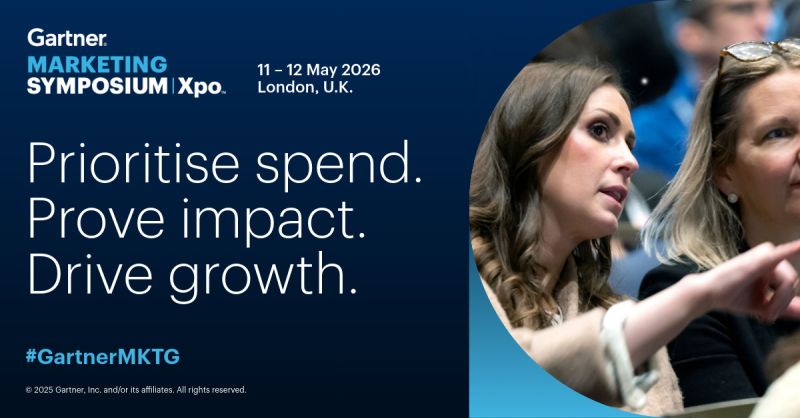
AI is rapidly changing the balance of power in marketing. But according to Gartner, the technology is not acting as a democratic force where everyone is given equal opportunities. On the contrary, AI risks amplifying the differences between companies that already have strong digital strategies and those that still lack the right skills, data and technical structure.
During Gartner Marketing Symposium/Xpo 2026 in London A clear picture was painted of a market where a few players are moving ahead at high speed. At the same time, the majority of companies are still struggling to translate AI investments into real business benefit.
Despite marketing managers currently spending around 15 percent of their budgets on AI, only 30 percent of organizations are considered ready to implement the technology on a larger scale.

Only 3 percent are classified as ”Genius Brands”
During the conference's Signature Series, Matt Moorut, Senior Director Analyst at Gartner, the results of a comprehensive analysis of 1,000 global brands. Only 3 percent qualified for the category ”"Genius Brands"”.
The differences between the top players and the rest of the market are dramatic. According to Gartner These brands are searched for twelve times more often on Google and generate almost nineteen times more website visits than their competitors.
But success is not primarily about producing more AI-generated content.
Instead, leading companies are using AI to strengthen their organizations’ skills, efficiency, and technical agility. While many companies continue to downsize their marketing teams, the most successful players are investing in more specialists in marketing technology, data analytics, and automation.
The focus is on building faster and more adaptable organizations where AI is integrated directly into workflows, decision-making and customer experiences.
AI also increases the risk of disinformation
Another central theme during the conference was how AI is changing the information landscape and at the same time increasing the risks of disinformation and manipulated messages.
Andrew Frank, Distinguished VP Analyst at Gartner, described AI as a ”brand risk amplifier.” Because modern AI search and answer engines no longer just index information but also interpret, summarize, and present it as ready-made answers, misinformation can quickly spread widely.
According to Frank, traditional crisis management or classic PR is no longer enough today.
Instead, he highlighted the need for what Gartner calls TrustOps, an operational method for continuously monitoring, verifying and protecting information associated with the brand.
With TrustOps, organizations can identify inaccuracies within minutes and publish human-reviewed responses within hours.
“Without TrustOps, even the most well-thought-out marketing strategy can be overshadowed by targeted disinformation within a matter of hours,” Frank warned.
Trust becomes more important than reach
As AI makes content faster, cheaper and easier to produce, what actually creates competitive advantage is also changing.
Amy Abatangle, Vice President Analyst at Gartner, emphasized that AI can simulate closeness and personal communication, but cannot create genuine human contact or true trust.
This means that companies that build strong relationships, expertise, and credibility will have a significantly greater advantage in the AI era.
Gartner describes the development as a shift towards Human Experience (HX), where authenticity, expertise, relationships and trustworthiness become central factors for the brands of the future.
“When trust becomes scarce, brands must stop chasing reach and instead build credibility signals,” said Abatangle.
AI is also changing visibility in search and algorithms
The consequences are not just about marketing and branding.
As AI-powered search and answer engines become increasingly important, how businesses are discovered digitally is also being impacted. Brands with strong credibility, high information quality, and clear signals of expertise are more likely to be prioritized in AI-generated answers and recommendations.
This means that the battle for online visibility will increasingly be decided by trust, data quality and technical maturity rather than advertising or content volume alone.
For many companies, this marks the beginning of a new AI-driven competitive situation where the difference between winners and losers quickly risks becoming significantly larger than before.












 Swedish
 Danish
 Norwegian
 Finnish
 English
 German
 Dutch
Dutch