




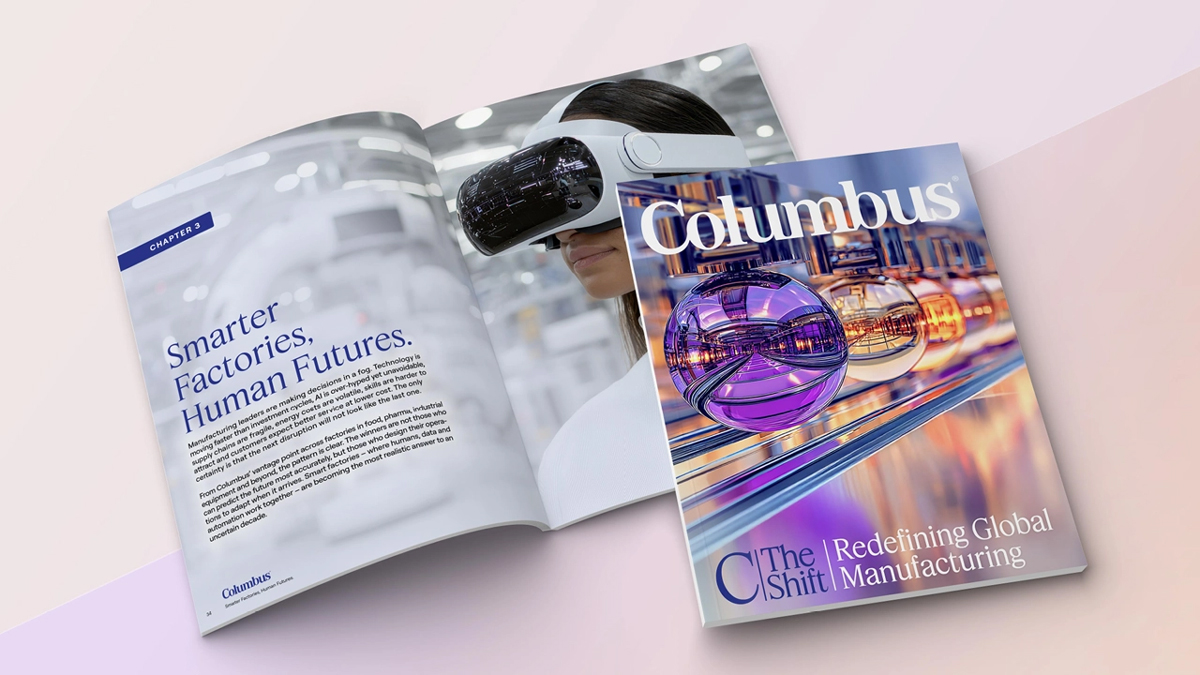

The manufacturing industry of the future is characterized by rapid technological shifts, increased sustainability requirements and a growing skills shortage. At the same time, the industry is entering a more uncertain time where new demands and changing conditions are reshaping competition.
It is stated in the report “C the Shift: Redefining Global Manufacturing“, published by the listed IT consulting company Columbus, headquartered in Denmark.
The report is based on interviews with industry leaders, researchers and experts and identifies five shifts – data, AI, security, skills and sustainability – that are now shaping the industry's competitiveness.



First comes the data issue. Many companies have large amounts of information but lack structure, quality and clear responsibility. This slows down decisions and digital investments, says Toby Mankertz, strategy manager for manufacturing at Columbus.
“You use local documents and spreadsheets, undocumented emergency solutions, and key figures that measure activity rather than progress. You need to build a foundation that can actually be trusted,” he says in the report.

The second shift concerns AI, where the technology is described as a change effort rather than a pure technology project. Kasper Lynge Jacobsen, AI Manager at the Danish Chamber of Commerce, points out in the report that companies that layer new technology on top of old ways of working risk reinforcing inefficiency.
The third shift is about value chains that are becoming increasingly connected and therefore more vulnerable. As products gain digital identities and need to be tracked throughout their entire lifecycle, the demands on systems that can exchange data securely increase.

Christine Charlotte Akselsen, CEO of Norwegian cloud company Kezzler, explains in the report that systems must speak the same language. Otherwise, even well-structured data gets stuck in silos, instead of flowing between, for example, subcontractors, logistics partners and customers.
“Trust is not something you can add afterwards. It has to be built into the architecture from the beginning,” she says.

The fourth shift is about skills. The workforce is aging while competition for technical skills is intensifying. Chalmers researcher Greta Brown describes it as a structural problem when an entire generation is soon retiring, while too few young people are applying to the industry.
She believes that it is not enough to recruit more people. Companies must make people want to stay.
“More women in technical education will not solve the problem. A workplace culture that makes them want to stay will,” she says.
The fifth shift is about sustainability. Companies that reduce energy use, material waste and resource consumption strengthen both profitability and competitiveness.

Steve Evans, Professor of Industrial Sustainability at the University of Cambridge, points out in the report that many companies are making the transition unnecessarily expensive.
“It is wrongly believed that sustainability requires expensive technology investments. The really big gains are instead found in using common sense to stop waste in factories,” he says.

Miying Yang, who is a professor of sustainability at Cranfield University, urges companies to ask themselves what value is being lost and to see the opportunities in, for example, repair and reuse.
“It's good to see what value you're creating. But you also need to see what value you're missing out on,” she says.

The report states that there is no one-size-fits-all model. Different industrial companies will need to take different paths. But those who will be most competitive are those who understand their business, adapt quickly and can demonstrate that changes deliver results.












 Swedish
 Danish
 Norwegian
 Finnish
 English
 German
 Dutch
Dutch