





Companies around the world are investing heavily in AI agents as a way to automate workflows, improve decision-making, and relieve employees. But as the technology matures, it is becoming increasingly clear that AI agents also create growing pains. Without coherent systems, they risk creating more complexity than business benefit.
This is shown by a global survey from Salesforce where 1,050 IT managers were interviewed. Nine out of ten respond that AI agents risk creating more work than value if they are not properly integrated into the business's IT environments.
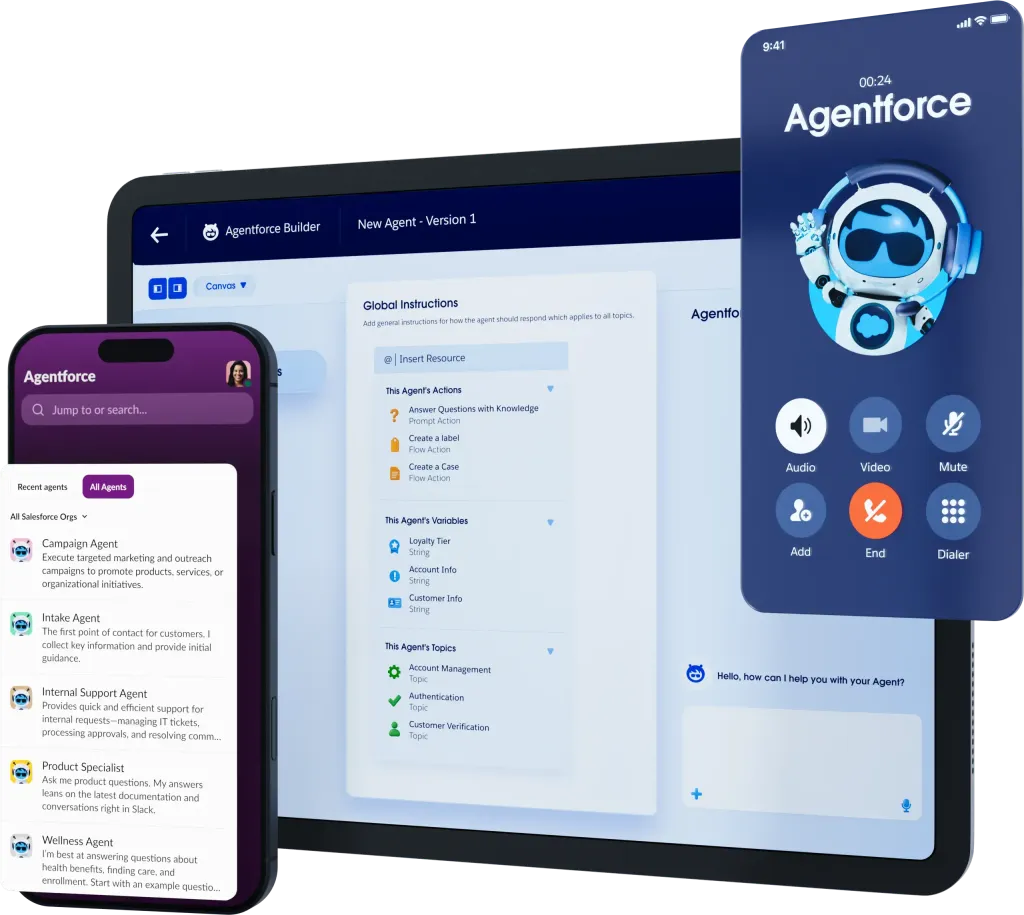
AI agents are used widely but often in isolation
Development is happening rapidly. Four out of five IT managers say they already use AI agents extensively in their organizations. On average, companies twelve AI agents in operation.

At the same time, the survey shows that many of these agents work in isolation. Half of agents today lack connectivity to each other or to central data sources. Only 54 percent of IT leaders say they have a common framework for governing and orchestrating AI agents.
This means that the agents' potential is limited despite a high level of technical ambition.
Security and competence slow down scaling
When IT leaders point out the biggest obstacles to scaling the use of AI agents, they end up compliance and security highest at 42 percent. Almost as many lift lack of expertise in AI and agent design as a crucial problem.
Overall, this points to AI agents no longer being an experimental technology project but a structural issue that requires both governance expertise and clear architectural choices.
Fragmented IT environments are the fundamental problem
One of the clearest explanations for the problems is the complex system landscape of companies. On average, organizations use 960 different applications, but barely a third of them are integrated.
Nearly all IT managers surveyed report that they struggle to get systems to work together, resulting in sluggish workflows, duplication of effort, and AI agents lacking access to the data they need to deliver value.
Swedish perspective from Salesforce
Jennifer Matheny responsible for Data Foundations at Salesforce in Sweden and recognize the image from the survey in the meeting with Swedish organizations.

“Success is not determined by how many agents or applications you have. It is determined by how well the agents can deliver together. AI agents only provide value when they are connected to business data and to functioning workflows,” says Jennifer Matheny.
She believes that many Swedish companies are still struggling to get basic system integration in place.
“Companies need to get a better handle on how their systems are connected. Otherwise, it will lead to sluggish processes and unnecessary duplication of work,” she says.
At the same time, she sees a clear movement in the right direction.
“More and more people are now investing in a more API-driven architecture where systems can easily connect and share information. This makes it possible to control and coordinate AI agents on a larger scale,” says Matheny.
The US and Asia are ahead of Europe
The survey also shows clear geographical differences. In the US, 48 percent of IT managers say they use AI agents in their operations. The corresponding figure in Europe is 35 percent, while Asia is at 41 percent.
The differences are also visible when comparing company size. Among mid-sized and large companies in the US, 48 percent have implemented AI agents compared to 33 percent in Europe.
Big differences between industries
In Europe, the technology and media sector leads with an implementation rate of 55 percent. The public sector follows closely with 52 percent, showing that AI agents are no longer limited to the private sector.
The slowest development is in retail, where only 12 percent have AI agents in place. The financial sector is also relatively low at 21 percent, but a rapid uptick is expected here. A full 58 percent of financial companies plan to introduce AI agents within the coming year.












 Swedish
 Danish
 Norwegian
 Finnish
 English
 German
 Dutch
Dutch