


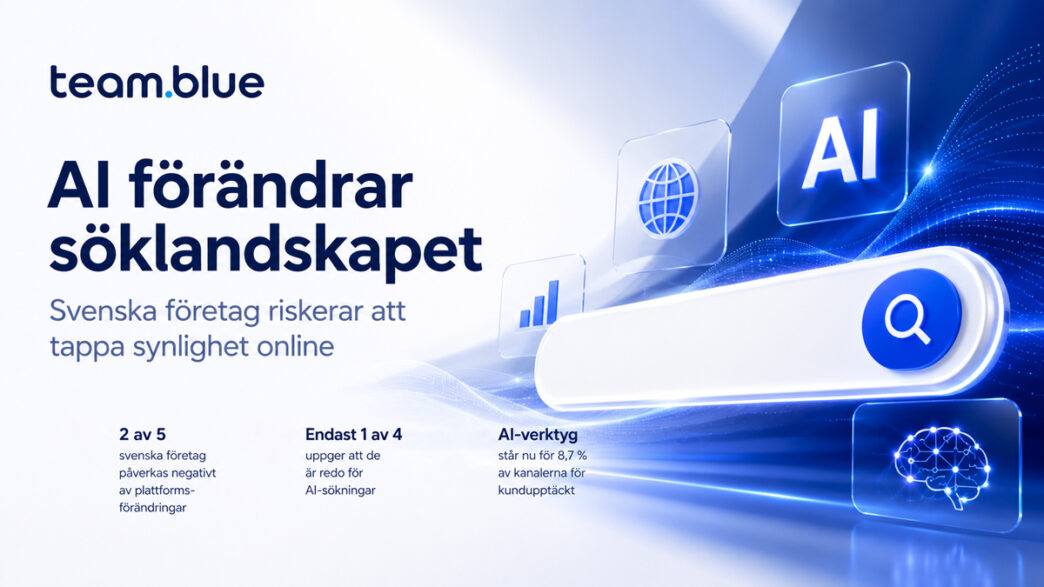
A survey from team.blue clearly shows that Swedish companies are not prepared for how AI will impact search functions and the way customers find companies online. Only a quarter say they are ready, while organizations' confidence that their brand is optimized for AI searches is low.
While the major search giants are implementing fundamental changes to their established search functions using AI, a new report shows that many companies are still unprepared for the big shift. According to State of European Business 2026 from team.blue, a provider of digital ecosystems, the biggest challenges consist of a fragmented search landscape, fundamental platform changes and sprawling tools – factors that lead to poorer online visibility and impact competitiveness in a more diversified brand landscape.
In the survey, almost one in three European companies (30.6 %) say that reaching customers online has become more difficult in the last two years. This is almost 1.5 times more than the proportion who think it has become easier (21.6 %). This is not a marginal concern, but the dominant view in Europe.

Platform changes are negatively affecting many Swedish companies: two in five (41.3 %) report that their business has been affected by disruptions to established platforms, which is slightly above the European average (39.6 %). At the same time, a fragmented tool landscape is another internal obstacle that creates disarray. The need for different systems increases as the digital presence changes. When everything from website tools, analytics tools, CRM systems, booking systems and compliance systems need to work together, the big challenge is not the number of systems, but how well they work together. Over half (51.5 %) of European companies report that their tools are only partially integrated or not integrated at all, which can lead to fragmented processes and increased disruption to the business.
Although the website is an important tool for controlling online visibility, the survey shows that the younger the company, the less likely it is to have a website. This makes new businesses more sensitive to platform changes by the big tech companies. Among European companies that are less than a year old, only 69.1 percent have a website, compared to 84.9 percent among companies that have been operating for one to three years. Among companies that have been in business for more than ten years, more than 90 percent have a website. In Sweden, only 80.9 percent say they have a website, which is the second lowest share in Europe and below the European average of 86.5 percent. At the same time, the average for how confident companies are that their websites are optimized for AI searches is only 4.37 out of 10.
The survey also shows how quickly customer discovery channels are changing. AI tools weren't part of the landscape three years ago, but are now 8.7 percent and surpasses traditional media such as TV, radio and print (4 %). Although AI tools still account for a relatively small share and lag far behind more traditional methods, such as offline recommendations (61.5 %) and search engines (56.5 %), the rapid development highlights a more diverse and rapidly changing landscape.
“AI is making it harder for companies to understand customer journeys and what drives growth, something we call ‘AI fog.’ At the same time, the problem is clearer than ever: we are inundated with new systems, features and technologies, but if these are not used effectively and in harmony with each other, chaos is inevitable.
”Reduced visibility is not an abstract obstacle far in the future, but something that is happening here and now and can have a huge impact on a brand’s competitiveness. Companies need to review their systems and platform choices to ensure they are integrated and evolving in step with AI,” says Alexander Liljeblad, Commercial Director at Loopia.
Read the full survey here.
Read more about team.blue here.
Methodology
The results are based on the survey State of European Business 2026, which was ordered by team.blue and was conducted in early 2026. The survey has collected responses from 10,059 companies in eleven European markets: Belgium, Bulgaria, Denmark, Ireland, Italy, the Netherlands, Slovakia, Spain, Sweden and the UK. Respondents represent organizations of all sizes, from freelancers and sole traders to large enterprises.
About team.blue
team.blue is a leading European provider of AI-powered digital services for businesses and entrepreneurs, helping over 3.3 million small and medium-sized enterprises in 22 countries. The company serves as a one-stop partner for, among other things, web hosting, domain names, e-commerce, digital compliance, lead generation and other SaaS solutions, with support from more than 4,000 specialists. The company's vision is to make it easier to succeed in online business by integrating AI capabilities into every step of the customer journey.







 Swedish
 Danish
 Norwegian
 Finnish
 English
 German
 Dutch
Dutch