


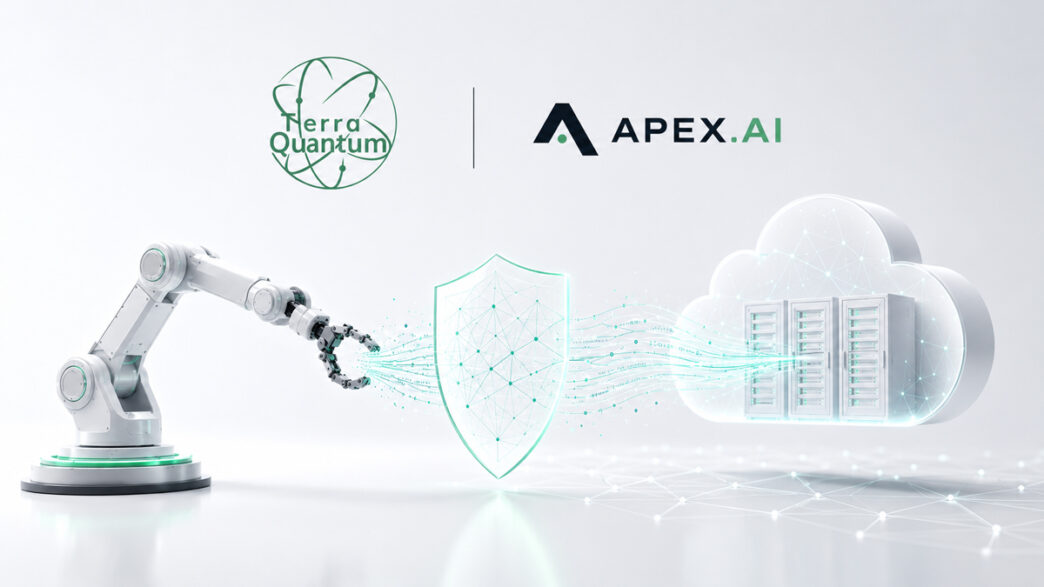
Terra Quantum and Apex.AI have demonstrated how standardized post-quantum cryptography can be used to protect communication between a robot-based software system and a cloud-based control system.
The implementation combines Terra Quantum's post-quantum cryptography technology with Apex.OS, Apex.AI:'s platform for software-defined robotics, autonomous systems, and intelligent machines. The goal is to provide long-lived and connected systems with better protection against future quantum computers without organizations having to rebuild their existing applications or communication architectures.
The demonstration included secure communication from edge to cloud with cryptographic algorithms that have been standardized by American National Institute of Standards and Technology, NIST. According to the companies, quantum-resistant security could be implemented while maintaining the system's existing communication flows and distributed software architecture.


This means that organizations can replace cryptographic components that risk becoming vulnerable in the long term, without changing the application logic or starting over with the entire development platform.
Quantum computers create a long-term security threat
Many of the algorithms that currently protect digital communications are based on mathematical problems that are very difficult for conventional computers to solve. However, sufficiently powerful quantum computers are expected to be able to attack many of the public key algorithms used for secure communication, identity verification and digital signatures.
The threat is particularly relevant for systems that are being developed today but are expected to be in operation for decades, such as software-defined vehicles, industrial robots, autonomous machines, defense systems, aircraft platforms, and other critical infrastructure.
These systems are increasingly dependent on continuous communication with cloud services for monitoring, diagnostics, software updates, remote control, coordination and management of vehicle or machine fleets, among other things. If the communication is based on cryptography that can later be broken, the security of the platforms risks deteriorating long before their operational lifespan is over.

– Connected intelligent systems are rapidly becoming critical infrastructure. The vehicles, robots and industrial systems that are being put into service today will still be used when quantum computers begin to challenge today's cryptographic standards, says Markus Pflitsch, founder, CEO and Chairman of the Board of Terra Quantum.
He emphasizes that organizations cannot wait until quantum computers pose a practical threat before beginning migration.
Preserves existing applications and workflows
A central part of the collaboration is that the post-quantum secure technology has been integrated without the need to change the application logic or fundamental communication models.
Instead of replacing the entire application environment, the cryptographic building blocks that are at risk of becoming vulnerable are replaced with standardized quantum-resistant alternatives.
This can reduce both the cost and technical complexity of the transition. For businesses with large installed systems, long product cycles, and extensive certification requirements, a complete rebuild can be expensive, time-consuming, and associated with new risks.
“The transition to post-quantum cryptography must be practical, standards-based, and compatible with the software systems that organizations already use,” says Florian Neukart, CTO at Terra Quantum.
According to him, the demonstration shows that the technology can be integrated into modern environments for robotics and software-defined vehicles while preserving established development flows.
Apex.OS connects machines, sensors and cloud services
Apex.OS consists of two central components: Apex.Grace and Apex.Ida.
Apex.Grace is a framework for developing and running reliable real-time applications. The platform is based on the programming interfaces from ROS 2 but has been extended with features for deterministic execution, security, system monitoring, and management of large machine and vehicle fleets, among other things.
Apex.Ida is communication software that transports data between sensors, computing platforms, vehicles, robots and cloud systems. It supports multiple communication protocols behind a common interface, making it possible to use the same application model in different types of distributed environments.
In the joint solution, Apex.OS serves as the foundation for the robotics and machine environment, while Terra Quantum's cryptographic technology protects communications against future quantum-based attacks.
“Software-defined vehicles, intelligent machines and connected defense systems are increasingly dependent on trusted communication with cloud infrastructure throughout their operational lifecycle,” says Jan Becker, CEO of Apex.AI.
He believes that post-quantum security should be addressed early in organizations' architectural and product planning, especially when developing platforms that will continue to be used for many years.
Relevant for robotics, manufacturing and defense
The technology is particularly relevant for industries that use connected and mission-critical assets with long lifecycles.
It includes robotics, autonomous mobility, industrial automation, manufacturing, logistics, aerospace, defense, and critical infrastructure. In these environments, devices installed today must be able to be protected for a period of time that may extend beyond the development of cryptographically relevant quantum computers.
The solution is also intended to be able to protect larger systems of interconnected systems, where cloud platforms, edge devices, autonomous machines and mission-critical networks need to exchange information.
The companies link this to NATO's work on multi-domain operations, where systems and information flows within land, air, sea, cyber and space need to be able to interact through resilient and interoperable communication environments.
For example, defense organizations may need to combine data from sensors, autonomous vehicles, command systems, and cloud-based analytics services. Security must then work throughout the entire communication chain, not just in a single unit.
Post-quantum migration can begin now
NIST published its first completed standards for post-quantum cryptography in 2024. The standards give companies, governments, and technology vendors a common foundation to begin replacing cryptography that could become vulnerable to future quantum computers.
Terra Quantum and Apex.AIThe companies say the demonstration shows that migration doesn't have to wait for future technology. Organizations can start implementing standardized algorithms into existing software-defined systems now.
This is especially important because cryptographic changes often impact many parts of a business. Certificates, identity management, software updates, APIs, cloud connections, and embedded systems can all rely on the same cryptographic infrastructure.
A gradual transition may therefore be more realistic than a comprehensive switch at a single point in time.
Cryptographic flexibility becomes crucial
The demonstration also illustrates the importance of cryptographic flexibility, often called crypto-agility. This means that an organization can change or update cryptographic algorithms without having to replace the entire underlying application.
For long-lived connected systems, this flexibility may become at least as important as the choice of a specific algorithm. Standards and threat scenarios will continue to evolve, meaning that platforms must be adaptable even after the initial migration to post-quantum cryptography.
Organizations therefore need to map out which cryptographic technologies are used, where they are located, and which systems depend on them. They also need to assess how long the information must remain protected and how long the affected products are expected to be in operation.
About Terra Quantum
Terra Quantum is a quantum technology company with operations in Germany and Switzerland. The company offers technology and services in quantum algorithms, quantum computing and secure communication through a model that the company calls Quantum as a Service.
In the area of security, developing Terra Quantum solutions for quantum-secure and post-quantum-secure communication for companies, authorities and mission-critical environments.
About Apex.AI
Apex.AI is an international software company that develops safety-certified and scalable platforms for software-defined vehicles, robotics and intelligent machines.
The company was founded in 2017 by Jan Becker and Dejan Pangercic and is headquartered in Palo Alto and operates in several international markets. The company's core platform Apex.OS includes the components Apex.Grace and Apex.Ida.





 Swedish
 Danish
 Norwegian
 Finnish
 English
 German
 Dutch
Dutch