



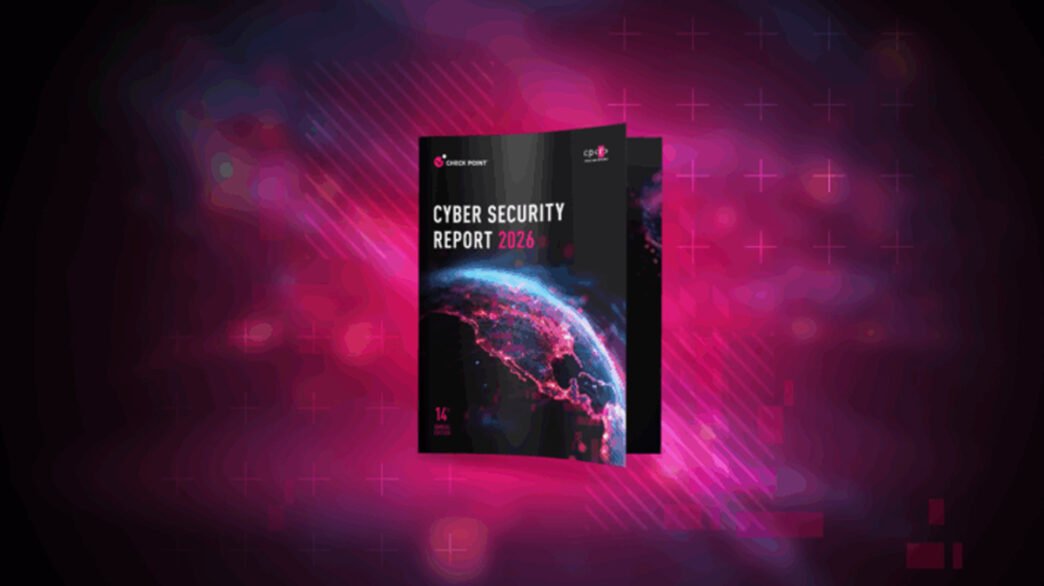
Cyberattacks in Europe continue to increase sharply, reaching new levels according to Check Point Cyber Security Report 2026. Cyberattacks against organizations increased significantly in Europe in 2025. The number of attacks per organization increased by 20 percent compared to the previous year, placing Europe among the regions where attacks are growing fastest.
The report shows that organizations globally were exposed to an average of 1,968 cyberattacks per week in 2025, a 70 percent increase since 2023. The same trend is visible in Europe, where attacks have become both more numerous and more frequent. For Swedish businesses, this means that daily exposure to intrusion attempts continues to increase, even without the organization being a specific target.
Attackers are increasingly using AI to streamline already established attack methods. The technology is used, among other things, to automate the mapping of organizations, adapt content for social manipulation and carry out parallel attacks across multiple digital channels. At the same time, the report shows that 89 percent of organizations globally have encountered risky AI use in their environments, which increases exposure when AI tools becomes part of daily work.


At the same time, the execution of attacks has changed. Social engineering is no longer primarily done via email, but is now coordinated across browsers, collaboration platforms, and telephones. One method that has grown rapidly is ClickFix, which according to the report increased by 500 percent during 2025 and where users are asked to follow technical instructions themselves which in practice gives attackers access to systems. Since the user himself performs the actions within ordinary systems, the attacks become difficult to distinguish from normal activity.

– We are now seeing how automation and AI are changing how cyberattacks are carried out in practice, says Oskar Rödin, security expert at Checkpoint Software. Attackers are working more systematically and with less reliance on individuals, which places new demands on how organizations build and monitor their basic security.
The report also shows that community-based activities are particularly vulnerable. Globally, education, the public sector and healthcare are among the most attacked sectors. In Sweden, the same pattern is visible in the sectors that are reported separately: the public sector was on average 3215 cyberattacks per week and organization over the past month, while healthcare was at 2,789 attacks.
– For Swedish organizations, this means that breaches not only risk affecting IT environments, but also the business's ability to maintain basic services, continues Oskar.
For more information, visit Check Point Software's blog: https://blog.checkpoint.com/research/the-trends-defining-cyber-security-in-2026-cyber-security-report-2026/










 Swedish
 Danish
 Norwegian
 Finnish
 English
 German
 Dutch
Dutch