



For many years, digital media has primarily competed on large reach figures. The number of page views, unique visitors and impressions have often been the most prominent key figures in the dialogue with advertisers, PR agencies and partners.
But the digital media market is changing.
As artificial intelligence, automation and advanced analytics tools develop, so does the view of what actually constitutes valuable media. For more and more advertisers, the question is no longer how many visits a website reports, but how many of those visits represent real people with a genuine interest in the content.



For marketers, traffic quality is therefore becoming an increasingly important part of the decision-making process when investments in digital advertising and PR should be evaluated.
From reach to quality
A high volume of traffic is still important, but it doesn't tell the whole story.
More and more media buyers and analysts are therefore supplementing traditional reach metrics with quality indicators that provide a more nuanced picture of a digital audience's true value.
Common questions are:
- Is the traffic mainly organic?
- What is the average engagement time?
- What percentage of readers return?
- Is there real interaction beyond page views?
- What does scroll depth and user behavior look like?
- Are the referral sources relevant and transparent?
- Does the traffic lead to actual business results?
A website may report hundreds of thousands of visits each month, but if a significant portion of the traffic consists of low-quality sessions or automated activity, the actual business value may be significantly lower than the overall numbers suggest.
This is why qualitative key figures are becoming increasingly important when evaluating digital media.
AI and automation are changing traffic
Artificial intelligence is used today for much more than content production.
The technology is also used in browser automation, testing environments, data collection, and various forms of automated workflows. At the same time, it has made it easier for malicious actors to create artificial traffic that can in some cases mimic human behavior.
Industry specialists in adtech, cybersecurity, and digital analytics have been warning for several years that automated traffic is becoming increasingly sophisticated.
The purpose may vary.
This could involve ad fraud, click fraud, or attempts to create an image of greater reach and higher activity than what real users actually generate.
Modern automated systems can, for example:
- Simulate scrolling.
- Generate mouse clicks.
- Emulate user sessions.
- Move the mouse pointer.
- Trigger analytics events.
- Navigate between multiple pages.
- Create advanced user journeys that resemble human behavior.
This doesn't mean that high traffic is automatically suspect. On the contrary, many serious publishers build their audience through quality journalism, strong organic visibility, and long-term trust.
But developments mean that large traffic volumes alone are no longer sufficient as proof of quality.
Therefore, traffic quality is being scrutinized more closely.
The global digital advertising market is worth hundreds of billions of dollars every year.
At the same time, several industry associations estimate that ad fraud and invalid traffic still cost the market significant amounts annually. As a result, both advertisers and media agencies have become significantly more careful in how they evaluate digital media.
In addition to traditional traffic metrics, the following are increasingly being examined:
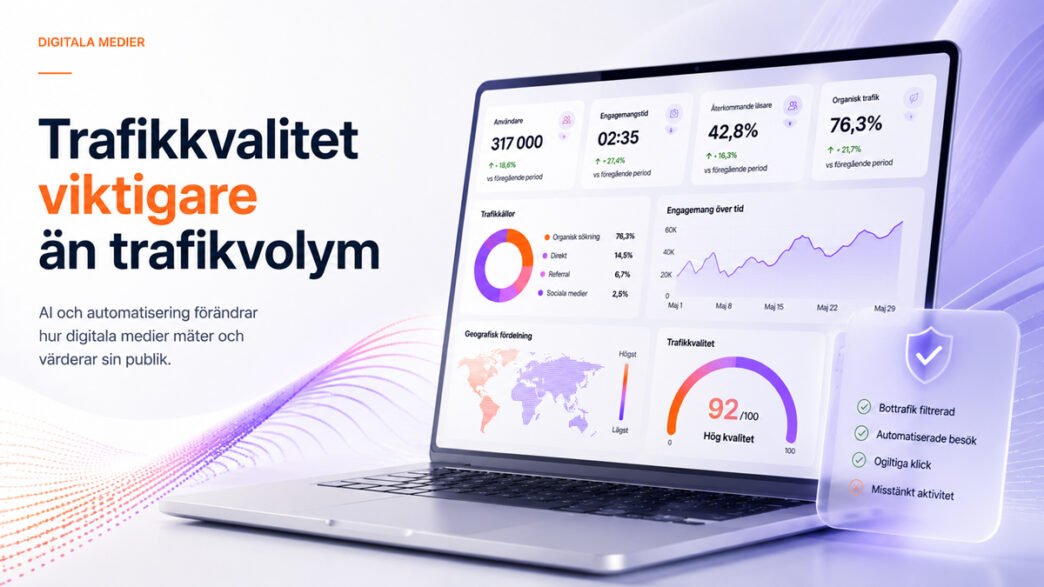
- Percentage of organic traffic.
- Repeat visitors.
- Commitment time.
- Scroll depth.
- The quality of referral sources.
- Geographic traffic patterns.
- Filtered and verified bot traffic.
- Conversions and actual business results.
The goal is not to find a single deviation, but to create an overall picture of the audience's quality and credibility.
When traffic patterns deserve closer analysis
Geographic traffic patterns are an example of a factor that is often analyzed.
If a medium reports very large traffic volumes from geographic areas where it lacks a natural target audience, local presence or editorial relevance, it may be a signal that justifies a deeper analysis.
That doesn't mean anything is wrong.
International exposure, search engines, social media, syndication or viral content can provide legitimate traffic spikes from many different parts of the world.
However, the combination of several deviating signals becomes more interesting to analyze.
Examples of indicators that analysts often look at are:
- Unusually large traffic volumes from a single city or region.
- Referral sources with limited transparency.
- Very short engagement time combined with high page views.
- Extremely high percentage of new users without recurring visits.
- Traffic patterns that don't match the content's target audience.
- Unusually low conversion despite high reported traffic.
No single data point proves anything.
It is only when several indicators point in the same direction that a more comprehensive analysis becomes relevant.
The KPI of the future is about quality
The digital media market is shifting focus from volume to quality.
More and more advertisers are therefore supplementing traditional traffic metrics with KPIs that better reflect the true value of the audience.
Examples of such indicators are:
- Organic traffic.
- Returning reader.
- Average engagement time.
- Scroll depth.
- Reading frequency.
- The quality of traffic sources.
- Verified bot filtering.
- Conversion rate.
- Business results linked to the content.
Developments show that the quality of the audience is becoming at least as important as the total reach.
Transparency becomes a competitive advantage
The increased use of AI means that the possibilities for automating both content and traffic continue to develop.
At the same time, market demands are increasing.
Advertisers, PR agencies and marketers increasingly want to understand what an audience actually looks like before they invest in a medium.
Questions that are becoming increasingly common are:
- What percentage of traffic is organic?
- What does engagement look like over time?
- How many readers return?
- How much of it comes from referral networks?
- How much traffic is filtered out as automated activity?
- How is traffic data verified?
- What proportion of the audience leads to real business results?
For serious media platforms, this represents an opportunity.
Publishers who openly report how traffic is built, how automated activity is handled, and how audience quality is measured can strengthen their trust with both advertisers and readers.
Digital credibility will be the next big competitive advantage
The Nordic media market is becoming increasingly data-driven.
At the same time, it is becoming clearer that large visitor numbers do not always mean great impact.
As the AI changes how traffic is created, distributed and analyzed, transparency becomes an increasingly important competitive factor.
For advertisers, it's no longer just about reach, but about understanding who is actually reading the content, how the audience engages, and what business value it creates.
For media houses which can show a high proportion organic traffic, returning readers, long engagement periods and transparent reporting, this becomes a strategic advantage.
In the coming years, the most important question will likely not be which medium reports the most visits.
The crucial question instead becomes:
How much of the audience consists of real people with genuine commitment?
In a time where AI blurs the line between human and automated activity, the answer to that question could become the most important currency in the digital media market.












 Swedish
 Danish
 Norwegian
 Finnish
 English
 German
 Dutch
Dutch