




A new global survey from Barracuda Networks shows that companies that take more than nine hours The time it takes to respond to an email breach is 79 percent risk to be affected by ransomware.
The report, Email Security Breach Report 2025, also reveals that 87 percent of Nordic companies – in Sweden, Denmark, Norway and Finland – have been subjected to at least one email breach in the past year.
For these organizations, the average cost of recovery is approximately SEK 900,000, which clearly illustrates how costly every hour of delay can be.
Smaller businesses are particularly hard hit
The economic consequences vary greatly depending on company size.
Organizations with 50 – 100 employees states average costs of SEK 18,000 per person, while larger companies with 1,000 – 2,000 employees reporting around SEK 2,200 per employee.
For smaller companies, this means that even a single breach can be a decisive setback – not only financially but also for the brand and customer relationships.
Barracuda emphasizes that rapid response and clear incident planning often determines whether an intrusion is limited in time – or leads to a full-scale attack with data leaks and downtime.



Complexity and lack of expertise slow down the reaction
Even though most business understand the importance of rapid incident management, the report shows that many lack the practical conditions to act in time.
Three factors recur in the responses:
- The increasing complexity of email threats and targeted attacks
- Lack of internal expertise and security resources
- The lack of automated discovery tools and response
“Email security is no longer just about stopping spam or phishing,” says Neal Bradbury, product manager at Barracuda Networks.
– It's about preventing the first domino from falling in a chain of cyber threats that can cause downtime, data loss and long-term damage to the business.
Bradbury explains that time is now a critical factor in all security incidents:
– The ability to detect and neutralize email intrusions is often hampered by increasingly sophisticated attacks, internal skills shortage and lack of automation.
A integrated security platform with centralized monitoring and rapid incident management is crucial to reducing risks.
The report's main findings
- 87 % of Nordic companies (78 % globally) have had an email breach in the past year
- 71 % of them were also affected by ransomware
- 41 % reports brand damage and lost business
- 900,000 SEK – average Nordic cost of restoration
- Only 50 % discovered the breach within an hour
- Organizations that take 9 hours or more to act runs 79 % risk for ransomware
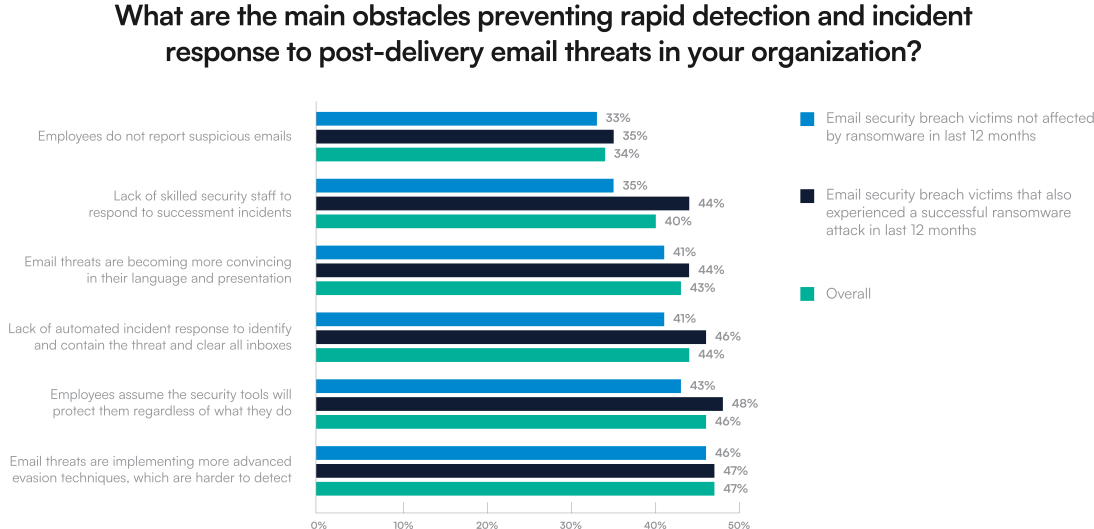
- 48 % in the Nordic countries, advanced attack technology is cited as the biggest obstacle
- 44 % Globally points to lack of automation as cause of slow response
Global study with a Nordic focus
The study was conducted by the independent research firm Vanson Bourne on behalf of Barracuda.
Over 2,000 senior IT and security decision-makers participated, representing organizations with between 50 and 2,000 employees in the US, UK, France, the DACH region, Benelux, the Nordics, Australia, India and Japan.
Data collection was carried out during April–May 2025 and covered a broad mix of industries, from finance and industry to the public sector and education.
The results indicate that The ransomware risk is universal, but that Nordic organizations have come somewhat further in their work with email security.
Nevertheless, there is a clear weakness: the lack of skills.
Many companies lack resources for 24/7 monitoring and lack the ability to quickly analyze threats that have already reached their inboxes.
The Way Forward: Faster Detection and Integrated Protection
Barracudas report shows that reaction time is the new front line in the fight against email threats.
Organizations that combine automated incident management, continuous training and centralized monitoring are significantly better equipped against today's attacks.
A unified protection strategy – where email, data, network and endpoint security come together – is the key to detecting threats in real time and stopping them before they take hold.
More and more Nordic companies are now prioritizing investments in integrated security platforms that can connect threat intelligence and AI-powered analytics.
For IT managers, this not only means reduced risk of ransomware but also the possibility of building a more resilient and sustainable digital infrastructure that can cope with the growing threat landscape of the future.










 Swedish
 Danish
 Norwegian
 Finnish
 English
 German
 Dutch
Dutch