


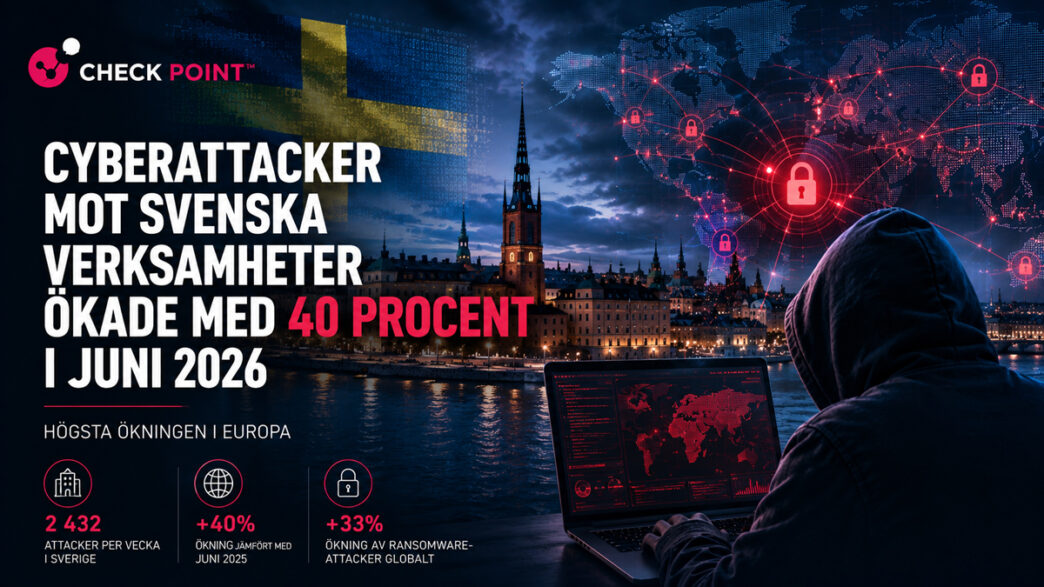

Swedish businesses were exposed to an average of 2,432 cyberattacks per week in June 2026, a 40 percent increase compared to the same month last year. At the same time, the number of ransomware attacks globally increased by 33 percent and a new player, The Gentlemen, took over as the most active ransomware group.
The IT security company Check Point Software The latest report shows that cyber threats continue to increase in both scope and complexity. Globally, organizations were exposed to an average of 2,270 cyberattacks per week in June, which is ten percent more than in May and 17 percent more than in June 2025. The development is visible in most regions, with Europe increasing by 22 percent compared to the previous year. Sweden is significantly above the European average with 2,432 attacks per organization per week, an increase of 40 percent in one year.
The public sector continues to be the most vulnerable in Sweden, closely followed by healthcare and the financial sector. What these businesses have in common is that they handle large amounts of sensitive information, while often having complex IT environments and many users. 



Meanwhile, ransomware continues to grow rapidly. In June, 646 public ransomware attacks were recorded globally, a 33 percent increase from the same month last year. The month also marked a shift in the threat landscape as The Gentlemen overtook Qilin to become the most active ransomware group. The group was behind 17 percent of the attacks and has Checkpoint Research has grown rapidly by combining ransomware with the sale of already compromised systems. Consulting firms were the hardest hit industry, followed by consumer goods and industrials.
– June shows that cyber threats are increasing on a broad front, says Omer Dembinsky, Data Research Manager at Check Point Research. Attackers are targeting more regions and industries, while ransomware groups continue to evolve and grow. The fact that The Gentlemen is now the most active ransomware group shows how quickly new actors can establish themselves as global threats. Organizations therefore need a proactive, AI-driven security approach that protects networks, users and data before attacks take hold.
For more information, read the full report at Check Points blog.








 Swedish
  Danish
  Norwegian
  Finnish
  English
  German
  Dutch
Dutch