



Today, AI can write texts, analyze data, and summarize meetings. Tomorrow, it will make decisions, approve workflows, and act directly in companies’ business systems. For many organizations, the biggest AI challenge is no longer which model to use, but which infrastructure controls what the model is actually allowed to do.
In recent years, generative AI has gone from being an experiment to becoming a natural tool in many businesses. Microsoft Copilot, ChatGPT Enterprise, Google Gemini, Salesforce Agentforce and other AI platforms are used already to streamline everything from customer service and marketing to software development and financial administration.
Now the companies are facing the next big step. 


AI is rapidly evolving from functioning as a digital assistant to becoming an autonomous actor that can perform tasks on its own. This development, often referred to as agentic AI, means that AI can not only answer questions but also plan, prioritize, use tools and carry out work steps in a company's operations.
For business management, this means the opportunity to automate significantly more than before. But it also means that a completely new technical question is at the top of the agenda: where in the architecture is the control over the actions of AI agents located?
The real competitive advantage is no longer about who has the most advanced The AI model. It's about who has the infrastructure to allow AI to act in a safe, transparent and controlled way. This is what is called AI Action Authority.
AI gains new powers
Imagine the following scenario.
An AI agent is assigned to help the finance department prepare for the month's financial statements.
In a few seconds it retrieves information from the company's ERP system, compare numbers against the CRM platform, analyzes supplier invoices, identifies discrepancies, sends questions to responsible managers and compiles a report to the CFO.
Technically, this is already possible.
The next step is for AI to not only recommend actions but also implement them.
It can create user accounts, update customer information, initiate purchases, start workflows, or communicate with other AI agents without a human needing to approve each step.
It is at that moment that a crucial component is missing from most IT environments: a layer of controls that determines whether each individual AI action should be approved, paused, reviewed, or blocked before it is executed.
The question is no longer whether AI can make decisions.
The question is which infrastructure determines which decisions it is allowed to implement.
Why policies and traditional governance are no longer enough
For many years, data governance has primarily been about data quality, information classification, and regulatory compliance.
Organizations have built data warehouses, cataloged information, and defined ownership of business-critical data. Many have also developed AI policies that outline how the technology can be used.
That work is still crucial.
But a policy document cannot stop an AI agent in real time.
When AI starts acting in business systems, the conditions change fundamentally. If customer data is incorrect, AI will draw the wrong conclusions. If authorization models are unclear, AI can gain access to information it should never have seen. If audit trails are missing, it becomes difficult to understand why an action was taken.
The difference from before is that the consequences no longer stop at an incorrect report. They materialize directly in the business, in the form of completed transactions, changed permissions or started processes.
This means that control over AI actions goes from being an administrative discipline to becoming a matter of technical infrastructure.
AI needs the same chain of control as humans, but at machine speed
A human employee typically does not have unlimited access to a company's system.
Permissions are governed by role, responsibility and business needs. Actions are logged. Sensitive decisions require approval.
The same principle needs to apply to AI.
An AI agent should not be able to read more information than the user initiating the task has the right to see. Nor should it be able to perform actions that the user himself does not have the authority to perform.
It may sound obvious, but in practice it is much more complicated.
Human actions happen at a human pace and can be reviewed by colleagues and managers. AI agents can execute hundreds of actions per minute, across multiple systems simultaneously. No manual approval process in the world can keep up with that pace.
Therefore, the control needs to be automated and built in as its own infrastructure layer: an instance between the AI model and the business systems that verifies identity in real time, checks authorization, applies policies, and logs every action before it reaches production.
The hidden risk lies between the systems
Many companies have invested significant resources in cybersecurity.
Firewalls, identity management, and endpoint protection have become standard.
But AI introduces a new type of risk.
The problem is rarely the language model itself. The problem arises when the model is given the opportunity to act in several different systems simultaneously.
An AI agent with access to Microsoft 365, SAP, Salesforce, ServiceNow, and internal databases quickly becomes a very powerful user. Each integration is often secured in itself, but there is rarely any component that sees the big picture and can assess the overall impact of a chain of actions.
This is exactly where an Action Authority layer belongs in the architecture: not inside any single application, but between the AI models and the systems where the actions have real impact.
If that layer is missing, the consequences can be extensive. It's not just about information security. It's about operational risk.
From AI projects to AI infrastructure
Over the past two years, many organizations have focused on testing AI.
Pilot projects have been carried out in HR, marketing, customer service and development.
The next phase is not about more pilots. It's about building the infrastructure that makes it possible to go from pilot to operation.
As AI becomes part of the core business processes, every action an AI agent wants to take needs to pass the same kind of checks that apply to humans and business systems. In practice, this means an infrastructure layer that handles:
- verified identity for each AI agent
- policy-based access and real-time permissions
- approval, pause, or block actions before they are executed
- continuous logging of each action and its underlying data
- traceability and version control throughout the entire decision chain
- risk assessment and continuous monitoring
For CIOs and CISOs, this means that AI Action Authority becomes as natural a part of the architecture as identity management and network security are today.
Regulations drive development
At the same time, regulatory requirements are increasing.
The EU AI Act establishes a common framework for how AI should be developed and used within the Union. In parallel, requirements are tightened through NIS2, DORA, GDPR and other regulations that affect how organizations protect information and document decisions.
What they all have in common is that they are based on transparency, responsibility and traceability.
Organizations need to be able to demonstrate:
- what information AI has used
- why an action was taken
- who is responsible for the decision
- what rules were applied
- how the process can be reviewed afterwards
These questions cannot be answered with a policy in a binder. The answers must be able to be retrieved from the infrastructure, from logs, decision points, and policy engines that were active when the action was taken.
For many companies, this will be significantly more difficult than implementing the AI technology itself.
Control infrastructure becomes a competitive advantage
Historically, control and governance have often been seen as something that slows down innovation.
That view is changing.
Organizations that have built infrastructure to control AI actions will be able to adopt AI faster than their competitors.
The reason is simple.
They dare to automate more work steps. They can give AI a greater mandate without increasing the level of risk. And they can show customers, partners and authorities exactly how the measures are controlled.
Trust thus becomes a strategic asset, and the infrastructure behind trust becomes a competitive advantage.
From policy to technical reality
Many organizations already have AI policies.
But a document is not enough when AI is given the opportunity to act.
Control needs to be built into the infrastructure.
It's about ensuring that each AI agent has a verified identity, defined permissions, and full traceability throughout the decision-making process, and that there is a technical authority that can approve, pause, review, or block each action before it affects data, systems, or processes.
Just like human users, AI needs to be authenticated, authorized, and audited. The difference is that for AI, this must happen automatically, in real time, and in every single action.
Only then can organizations create a secure foundation for large-scale AI.
VORTIQ-X sees a growing need for control infrastructure
This development is also noticeable among companies working with AI Action Authority and identity management.
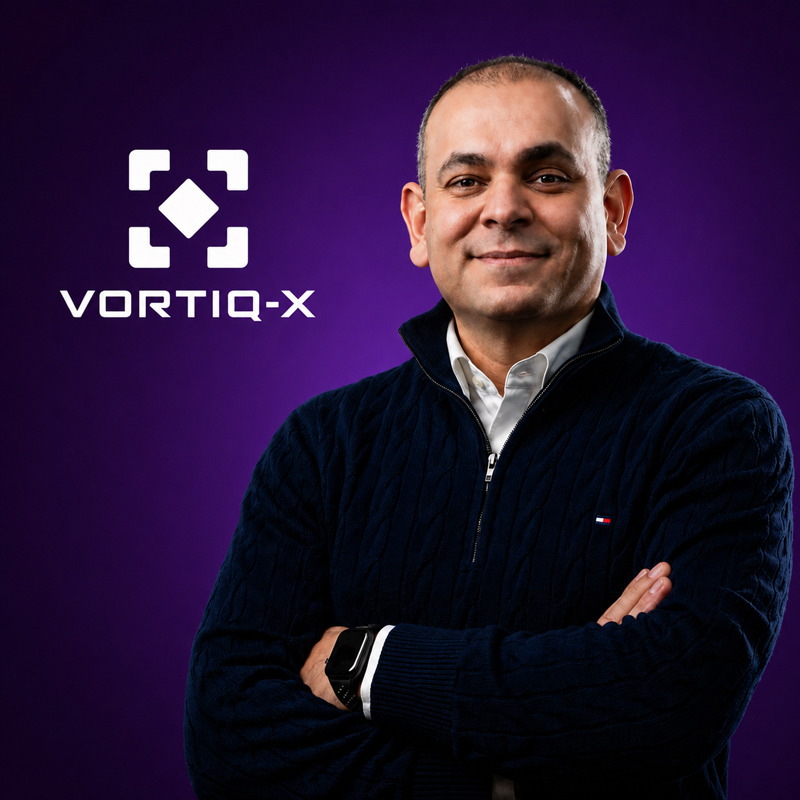
According to VORTIQ-X The demand for infrastructure that combines AI Action Authority, data governance, and secure identity management is growing as companies move from AI pilots to mission-critical implementations.
The goal is not to limit AI.
The goal is to provide organizations with a technical foundation for using AI with the same level of control, accountability, and transparency as human users.
This means that AI permissions are linked to established identity models, that every action is verified before it is carried out, that everything is logged and that decisions can be reviewed afterwards.
For businesses in areas such as finance, the public sector, healthcare and critical infrastructure, this can be a crucial prerequisite for being able to scale AI in a responsible manner.
VEKTRAL shows that control and efficiency are not contradictory
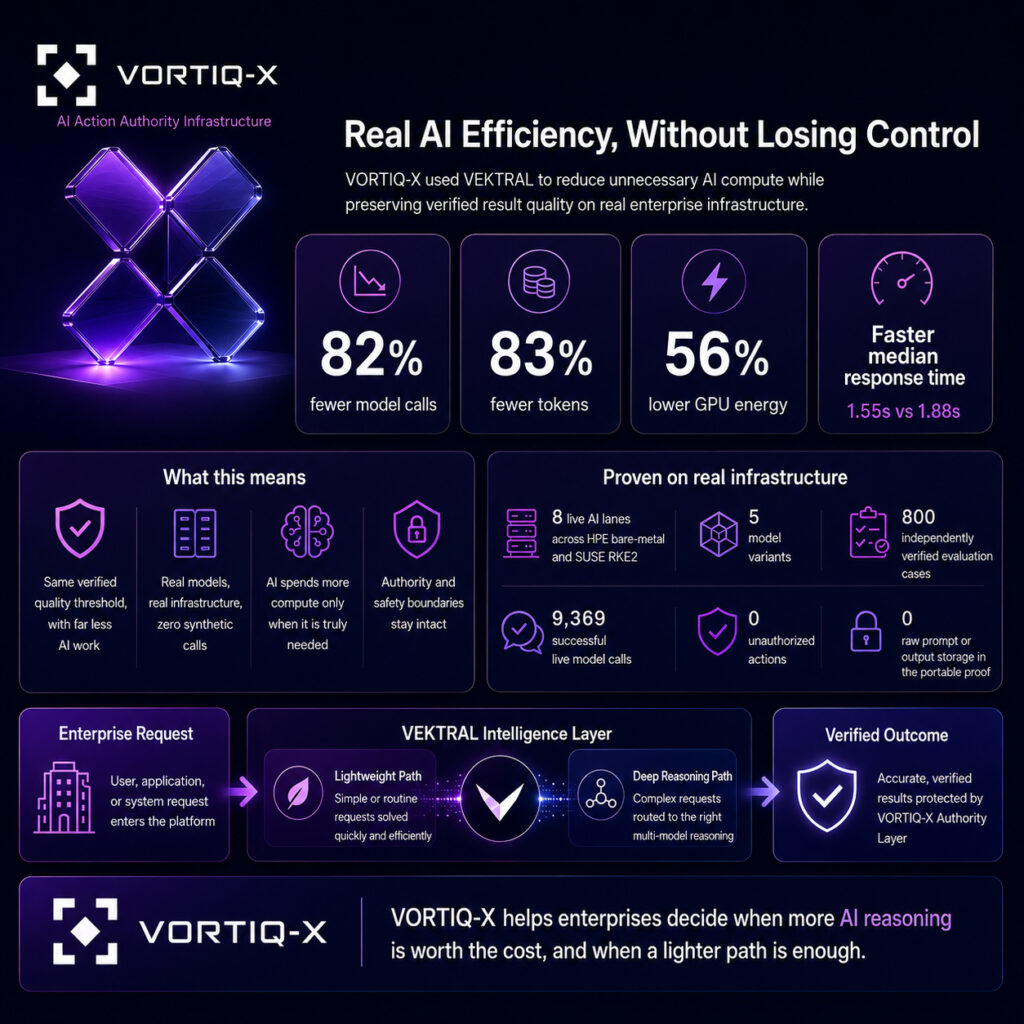
A common counterargument against control infrastructure is that it would make AI slower and more expensive. VORTIQ-X's own results with the VEKTRAL intelligence layer point in the opposite direction.
VEKTRAL acts as an intelligence layer that determines how much AI reasoning a query actually requires. Simple and routine queries are resolved via a lightweight path, while complex queries are routed to deeper reasoning across multiple models. Authority and security boundaries are fixed regardless of the path.
The results from runs on real enterprise infrastructure speak for themselves:
- 82 percent fewer model calls
- 83 percent fewer tokens
- 56 percent lower GPU power consumption
- faster median response time, 1.55 seconds compared to 1.88 seconds
This was achieved with the same verified quality threshold, with real models on real infrastructure and without synthetic calls. The AI adds more computing power only when it is really needed.
The figures come from an environment with eight live AI lanes on HPE bare-metal and SUSE RKE2, five model variants, 800 independently verified evaluation cases, and 9,369 live model invocations executed. Throughout the entire run, zero unauthorized actions were recorded, and no raw prompts or output were stored in the portable evidence.
The bottom line for business leaders is simple. A properly built control infrastructure doesn’t slow down AI. It helps the organization determine when more AI reasoning is worth the cost, and when an easier path will suffice.
Five questions every CIO should ask before AI agents are given greater mandate
As AI begins to integrate with business-critical systems, management needs to be able to answer some fundamental questions:
- Do we know exactly which systems our AI agents have access to?
- Are AI permissions limited to the same level as the human user?
- Can we see in retrospect every action AI has taken and what data was used?
- Is there a technical control layer that can stop AI from performing actions outside of defined policies, before they are executed?
- Is our AI infrastructure adapted to the EU's upcoming regulations and our internal security requirements?
If the answer to any of these questions is no, then part of the Action Authority infrastructure that needs to be in place before AI is given greater operational responsibility is likely missing.
The future of AI is about trust
The debate around artificial intelligence has long been about models, performance and productivity.
In the coming years, the focus will shift.
The most important question will not be how intelligent AI is.
The most important question is which infrastructure controls what it is allowed to do.
Companies that invest in AI Action Authority, clear data governance, and modern identity management will be significantly better positioned to take advantage of AI's capabilities without compromising security, transparency, or compliance.
When AI moves from assisting people to acting on their behalf, the control infrastructure no longer supports the business.
It will become the very foundation for the digital companies of the future.
About VORTIQ-X
VORTIQ-X Consilium is an AI company with Swedish intellectual property that develops an AI Action Authority platform, designed to give organizations control over AI-driven actions before they impact data, business systems, infrastructure or mission-critical processes.
The platform acts as a control layer between AI models and the real world by verifying whether an AI action should be approved, paused, reviewed, or blocked before it is executed. The solution is designed for businesses with high demands on security, transparency, compliance, and ultimate control over AI, and can be deployed in customer-controlled environments, including private, on-premises, and air-gapped installations.
The focus is on AI Action Authority, AI governance, cybersecurity, identity management, data governance and traceability for companies in critical infrastructure, finance, the public sector and other regulated industries.
Read more about VORTIQ-X: https://vortiqxconsilium.com/alpha-firewall








 Swedish
  Danish
  Norwegian
  Finnish
  English
  German
  Dutch
Dutch